Caseolus baixoensis
Overview
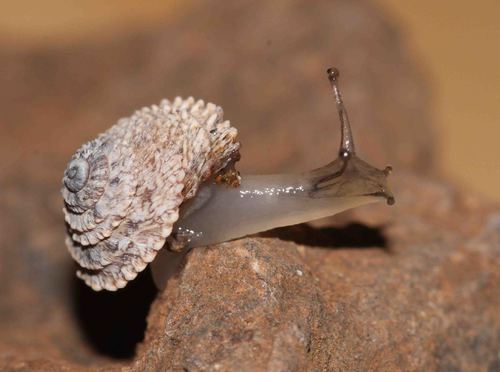
Caseolus baixoensis is a small land snail endemic to the Madeiran archipelago, part of a remarkable radiation of Caseolus species that evolved in isolation on these Atlantic islands. Like its relatives, it possesses a low, flattened, disc-shaped shell adapted to life on rock faces and crevices, allowing it to shelter from sun exposure and predators in its narrow rocky habitat. The species is confined to a highly restricted range on Madeira, where it inhabits calcareous or volcanic rock outcrops, cliffs, and associated rocky substrates, often in coastal or lower-elevation zones.
This extreme range restriction, combined with ongoing habitat degradation from development, agricultural expansion, and the drying effects of altered land use in Madeira's limited lowland habitats, has placed severe pressure on remaining populations. Invasive predatory species and competition from introduced snails and slugs further compound the threats facing this and other Madeiran endemic land snails. Caseolus baixoensis is classified as Critically Endangered (CR) by the IUCN, reflecting its extremely limited distribution, ongoing habitat loss, and the fragility of populations confined to a handful of rocky sites.
Population trends remain unknown due to the difficulty of surveying cryptic rock-dwelling mollusks, but the species' narrow endemism alone places it among the most vulnerable invertebrates in the Macaronesian region. On a positive note, Madeira's unique and diverse land snail fauna has drawn increasing conservation attention in recent decades, with habitat protection measures and biodiversity surveys on the island helping to document and safeguard remaining rocky habitat fragments that support this and related endemic species. Continued monitoring and habitat conservation offer a pathway toward better understanding and protecting this rare Madeiran mollusk.
Caseolus baixoensis faces severe threats from habitat destruction due to urban development and agricultural expansion on Porto Santo Island. The species' extremely limited range makes it particularly vulnerable to introduced species, especially invasive plants that alter soil chemistry and native vegetation structure. Climate change poses an additional threat through increased drought conditions that could further degrade the already fragile semi-arid habitats this endemic snail depends upon.
Habitat
This endemic land snail inhabits the semi-arid coastal areas and rocky slopes of Porto Santo Island in the Madeira archipelago. It is typically found among native vegetation and rocky crevices in areas with specific soil conditions and microclimate requirements.
Conservation measures underway
Other threatened species in GEOMITRIDAE
Threatened in Portugal
Frequently asked questions
Why is Caseolus baixoensis classified as Critically Endangered?
Where does Caseolus baixoensis live?
What are the main threats to Caseolus baixoensis?
Get weekly conservation intelligence
One short digest a week of the most striking species and country data we ship, plus breaking conservation news paired with our database where it matters.
Free, no spam. One-click unsubscribe in every email.