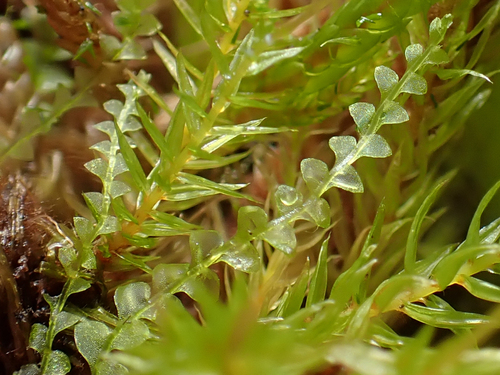
Bog Pouchwort
Calypogeia sphagnicola
Photo: iNaturalist: (c) John D Reynolds, some rights reserved (CC BY-NC), uploaded by John D Reynolds
Overview
Bog Pouchwort is a small leafy liverwort belonging to the genus *Calypogeia*, characterized by its creeping, prostrate growth habit and pouch-like structures (marsupia) that protect developing spores. Like other liverworts, it lacks true roots, stems, and leaves in the vascular sense, instead absorbing moisture and nutrients directly through its thallus-like tissue. As a bryophyte specializing in peatland environments, it contributes to the structural complexity of bog surfaces and plays a role in the broader hydrological and carbon-cycling functions of these ecosystems, often growing in close association with *Sphagnum* moss mats.
The species has an unusually wide global distribution for a peatland specialist, recorded across Northern and Western Europe, North America, and scattered locations in the Southern Hemisphere, including Chile, New Zealand, and Australia. This disjunct range reflects its dependence on a specific habitat type—undisturbed *Sphagnum*-dominated bogs and mires—rather than broad ecological tolerance.
Its Critically Endangered status stems from ongoing degradation of bog habitats: drainage for agriculture and forestry, commercial peat extraction, altered hydrology linked to climate change, and nutrient pollution that disrupts the acidic, nutrient-poor conditions bogs require. Population trends are currently unknown, limiting precise assessment of decline rates.
Conservation responses are largely indirect, occurring through peatland protection and restoration initiatives, wetland designations, and international agreements targeting bog ecosystems generally, rather than species-specific programs. Given the continued, unabated pressures on peatlands across its range, the species' outlook remains precarious, with habitat loss and hydrological disruption expected to persist without stronger, targeted intervention.
Bog Pouchwort is losing its wetland homes as bogs are drained and converted for farming, and as peat is dug up and harvested for commercial use. It's also being harmed by pollution running into these wetlands and by changing rainfall and water patterns linked to climate change, both of which dry out or disrupt the boggy conditions it needs to survive. These threats are ongoing and show no signs of letting up, suggesting the pressure on this species remains steady to intensifying.
Habitat
Bog Pouchwort inhabits acidic Sphagnum bogs and wet heathlands, where it grows among cushions of Sphagnum moss in permanently waterlogged, nutrient-poor conditions. This species is typically found in the wettest areas of ombrotrophic bogs, often in shallow pools or along bog margins where the water table remains consistently at or near the surface.
Other threatened species in Calypogeiaceae

Threatened in Åland Islands


Frequently asked questions
Why is Bog Pouchwort classified as Critically Endangered?
Where does Bog Pouchwort live?
What are the main threats to Bog Pouchwort?
Get weekly conservation intelligence
One short digest a week of the most striking species and country data we ship, plus breaking conservation news paired with our database where it matters.
Free, no spam. One-click unsubscribe in every email.