Dusky Meagre
Argyrosomus japonicus
Overview
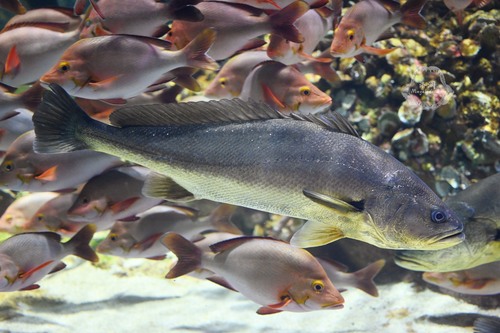
The Dusky Meagre is a large, silvery fish in the family Sciaenidae, known for its elongated body, bronze-grey flanks, and the deep croaking sound it produces using its swim bladder, particularly during spawning aggregations. Adults can reach substantial size and age, and the species is a predatory carnivore, feeding on smaller fish and crustaceans, playing a role as a mid-to-upper trophic level predator in coastal marine food webs.
This species inhabits rocky areas, marine oceanic, coastal, and neritic zones, typically found in nearshore waters, estuaries, and surf zones. Its distribution spans a wide range of countries including Australia, South Africa, Mozambique, South Korea, Japan, Vietnam, Indonesia, India, Sri Lanka, Pakistan, Oman, and Hong Kong SAR China, reflecting its presence across Indo-Pacific and southwestern Indian Ocean coastal systems.
The species is threatened primarily by targeted and incidental fishing, both commercial and recreational, which places direct pressure on adult breeding stock. Additional pressures include problematic native species interactions or disease, and droughts affecting estuarine nursery habitats critical to juvenile development. Broader coastal habitat degradation linked to land-based activities such as logging further compounds these impacts by altering runoff and estuarine conditions.
Conservation responses include fisheries management measures such as size and bag limits, seasonal closures, and monitoring of spawning aggregations in some range states, notably South Africa and Australia, where population assessments have informed harvest controls. Enforcement and habitat protection remain inconsistent across its broader range.
Population trends remain in decline despite these localized interventions. Continued fishing pressure and habitat vulnerability suggest that without stronger, range-wide enforcement and estuarine habitat safeguards, recovery is unlikely in the near term.
The Dusky Meagre faces ongoing pressure from fishing and hunting activities that directly target it, along with competition or predation from other native species. Habitat and ecosystem changes from droughts and logging or wood harvesting in surrounding areas also add to the strain. Based on the available information, these threats appear to be continuous and stable rather than clearly worsening or improving.
Habitat
Conservation measures underway
Other threatened species in SCIAENIDAE


Threatened in Australia
Frequently asked questions
Why is Dusky Meagre classified as Endangered?
Where does Dusky Meagre live?
What are the main threats to Dusky Meagre?
Get weekly conservation intelligence
One short digest a week of the most striking species and country data we ship, plus breaking conservation news paired with our database where it matters.
Free, no spam. One-click unsubscribe in every email.