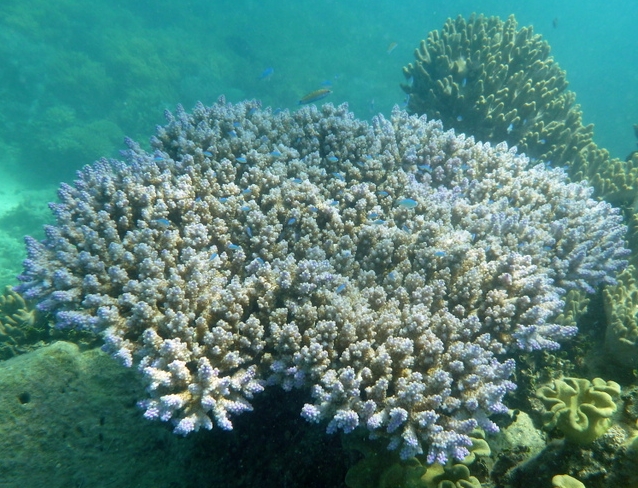
Acropora valida
Photo: Wikimedia Commons (CC) via https://en.wikipedia.org/wiki/Acropora_valida
Overview
Acropora valida is a stony coral belonging to the family Acroporidae, forming colonies with thick, short branches arranged in corymbose or bushy formations. Like other Acropora species, it is a colonial organism composed of thousands of individual polyps that secrete a calcium carbonate skeleton, contributing to the structural framework of reef systems. It hosts symbiotic zooxanthellae algae, which provide the coral with energy through photosynthesis while giving colonies their characteristic coloration.
As a reef-building species, it provides critical habitat and shelter for a wide range of marine invertebrates and fish.
This species inhabits rocky substrates and marine neritic zones, typically in shallow, well-lit reef environments. Its known range includes waters off the United States, Australia, Vietnam, China, and Japan, reflecting a broad but increasingly fragmented Indo-Pacific distribution.
The species faces numerous ongoing pressures. Coastal mining and quarrying degrade reef habitat, while fishing and harvesting activities cause direct physical damage and disturbance. Recreational activities, including tourism-related contact, add further stress.
Pollution from domestic wastewater, agricultural runoff, and non-timber crop cultivation contributes to declining water quality, reducing light availability and increasing susceptibility to disease. Invasive species and disease outbreaks, including coral predators and pathogens, compound these effects. Habitat shifting linked to broader environmental change further undermines reef stability.
Conservation efforts include inclusion in marine protected areas across parts of its range, international trade regulation under CITES, and ongoing reef monitoring programs. Restoration initiatives, including coral gardening and transplantation trials, are being tested in several countries, though implementation remains localized.
Given the breadth and persistence of threats, particularly water quality degradation and disease, the population trend remains decreasing. Without substantial reduction in cumulative stressors, the species' conservation outlook remains concerning.
Acropora valida, a type of coral, is threatened by coastal development activities like mining and quarrying, along with pollution from sewage, farm runoff, and other waste entering the water. It also faces pressure from fishing and harvesting practices, disease, competition from invasive species, and climate-related changes that alter its reef habitat. These combined pressures appear to be ongoing and stable rather than clearly increasing or decreasing.
Habitat
Conservation measures underway
Other threatened species in ACROPORIDAE

Threatened in Australia
Frequently asked questions
Why is Acropora valida classified as Endangered?
Where does Acropora valida live?
What are the main threats to Acropora valida?
Get weekly conservation intelligence
One short digest a week of the most striking species and country data we ship, plus breaking conservation news paired with our database where it matters.
Free, no spam. One-click unsubscribe in every email.