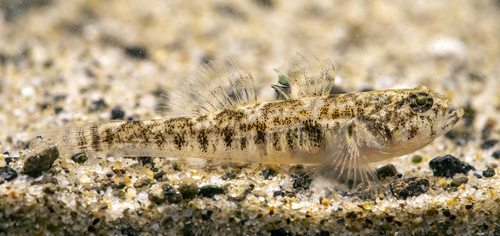
Acheron Spring Goby
Knipowitschia milleri
Photo: Photo: (c) davide bellucci, some rights reserved (CC BY-NC), uploaded by davide bellucci
Overview
Knipowitschia milleri is a critically endangered freshwater goby endemic to the Corinth region of Greece, representing one of Europe's most geographically restricted fish species. This small goby, typically measuring 3-4 centimeters in length, displays the characteristic elongated body and large eyes typical of its genus, with males developing darker coloration and enlarged fins during breeding season. The species inhabits shallow freshwater springs, small streams, and associated wetland areas within the narrow coastal plain near Corinth, where it prefers areas with sandy or muddy substrates and moderate vegetation cover.
Its extremely limited range, confined to just a few interconnected water bodies, makes it one of the most range-restricted vertebrates in Europe. Knipowitschia milleri exhibits typical goby behavior, with males establishing small territories around suitable spawning sites and females depositing eggs on hard surfaces or vegetation. The species feeds primarily on small invertebrates, zooplankton, and organic detritus found in the sediment.
As a Critically Endangered species under IUCN classification, K. milleri faces severe extinction risk due to its tiny population size and restricted habitat. However, recent conservation efforts have brought renewed attention to protecting the remaining spring systems, and local environmental groups have begun monitoring water quality in key habitats.
The species' survival depends entirely on maintaining the ecological integrity of these few remaining freshwater refugia, making targeted habitat protection essential for preventing extinction.
Knipowitschia milleri faces extinction primarily due to habitat destruction and degradation of the limited freshwater springs and streams it depends upon near Corinth. Urban development, agricultural expansion, and water extraction for human use have severely reduced and fragmented the species' already tiny habitat range. Water pollution from agricultural runoff and urban sources further degrades the quality of remaining habitats, while the introduction of non-native fish species creates additional competitive pressure on this highly specialized endemic goby.
Habitat
This species inhabits shallow freshwater springs, small streams, and associated wetland areas within the coastal plain near Corinth, Greece. It prefers areas with sandy or muddy substrates, moderate aquatic vegetation, and clean, slow-flowing or still water with temperatures typically ranging from 15-25°C.
Conservation measures underway
Other threatened species in GOBIIDAE
Threatened in Greece
Frequently asked questions
Why is Acheron Spring Goby classified as Critically Endangered?
Where does Acheron Spring Goby live?
What are the main threats to Acheron Spring Goby?
Get weekly conservation intelligence
One short digest a week of the most striking species and country data we ship, plus breaking conservation news paired with our database where it matters.
Free, no spam. One-click unsubscribe in every email.