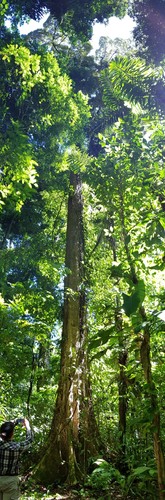
Parinari parvifolia
Local name: ã-kiavũ, ã-kiavunõ
**Parinari parvifolia (ã-kiavũ, ã-kiavunõ)** Parinari parvifolia is a tree species belonging to the Chrysobalanaceae family, known locally by the indigenous names ã-kiavũ and ã-kiavunõ. This species produces small fruits and likely serves as a food source for local wildlife, though detailed ecological studies remain limited.
6
Countries
Photo: iNaturalist: (c) Leonardo Álvarez-Alcázar, some rights reserved (CC BY-NC), uploaded by Leonardo Álvarez-Alcázar
Taxonomy & Classification
Kingdom
Plantae
Phylum
Tracheophyta
Class
Magnoliopsida
Order
Malpighiales
Family
Chrysobalanaceae
Genus
Parinari
Parinari parvifolia belongs to the family Chrysobalanaceae, order Malpighiales, within the Magnoliopsida class.
Species Profile
**Parinari parvifolia (ã-kiavũ, ã-kiavunõ)** Parinari parvifolia is a tree species belonging to the Chrysobalanaceae family, known locally by the indigenous names ã-kiavũ and ã-kiavunõ. This species produces small fruits and likely serves as a food source for local wildlife, though detailed ecological studies remain limited. Like other members of the Parinari genus, it probably plays a role in forest ecosystem dynamics through seed dispersal relationships with animals. The species is endemic to specific regions of South America, though its precise geographic distribution requires further documentation. It inhabits tropical forest environments, but comprehensive habitat assessments have not been completed to determine its specific ecological requirements or preferred forest types. The classification as Critically Endangered indicates severe risk of extinction, though the specific threats facing P. parvifolia have not been formally assessed. Given the pattern for similar Neotropical tree species, potential threats likely include habitat loss from deforestation, agricultural expansion, and land-use changes, but these remain unconfirmed for this particular species. Conservation measures for P. parvifolia are not well-documented, reflecting the broader challenge of protecting poorly-studied tropical species. The lack of comprehensive threat assessments and habitat evaluations indicates that conservation planning is still in preliminary stages. The current outlook for P. parvifolia remains highly uncertain due to insufficient data on population trends, distribution, and threats. The Critically Endangered status suggests urgent conservation attention is needed, but effective protection strategies cannot be developed without fundamental research on the species' ecology, distribution, and specific conservation requirements.
The threats to ã-kiavũ, ã-kiavunõ (Parinari parvifolia) have not been formally assessed or documented by conservation scientists. Without this assessment, it's unclear what specific dangers this species may be facing in its natural habitat. The trend of these unknown threats cannot be determined until a proper scientific evaluation is conducted.
Key Facts
Threats
IUCN Red List: Critically Endangered
The threats to ã-kiavũ, ã-kiavunõ (Parinari parvifolia) have not been formally assessed or documented by conservation scientists. Without this assessment, it's unclear what specific dangers this species may be facing in its natural habitat. The trend of these unknown threats cannot be determined until a proper scientific evaluation is conducted.
Detailed threat classification data is sourced from IUCN assessments as they become available.
Found in 6 Countries
Community Sightings
Report a sightingNo community sightings yet. Be the first to report!
Sources & Attribution
How to Cite
IUCN: IUCN (2025). The IUCN Red List of Threatened Species. Version 2025-1. Available at: https://www.iucnredlist.org. doi:10.2305/IUCN.UK.2025-1.RLTS
GBIF: GBIF.org (2025). GBIF Home Page. Available at: https://www.gbif.org
This page: SpeciesRadar (2025). Parinari parvifolia (Parinari parvifolia). SpeciesRadar: Intelligence for Earth's Biodiversity. Available at: https://speciesradar.org/species/a-kiavu-a-kiavuno