Australian Sandalwood
Santalum spicatum
Overview
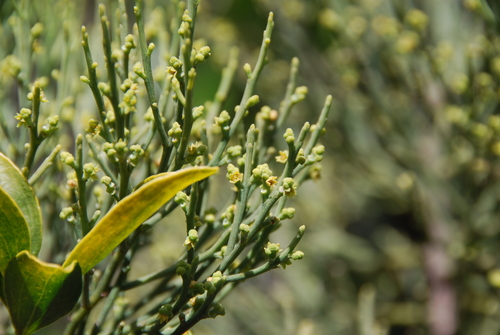
Santalum spicatum is a slow-growing hemiparasitic tree or shrub, typically reaching 3–6 metres in height, that draws water and nutrients from the root systems of neighbouring host plants while photosynthesising independently. Its fragrant heartwood, the source of commercially valuable sandalwood oil, forms only after decades of growth. The species produces small, inconspicuous flowers followed by nut-like fruits that are dispersed by birds and mammals, and within arid and semi-arid ecosystems it contributes to soil stability and provides food resources for native fauna.
The species is found across Western Australia, where it is widespread, and extends into southern South Australia. It occupies a range of habitats including forest margins, shrubland, desert fringes, and coastal supratidal zones, often persisting in disturbed or artificial terrestrial landscapes alongside agricultural land.
Population decline stems from a combination of pressures. Historical and ongoing harvesting for its valuable oil-bearing wood has removed mature, seed-producing individuals. Clearing for annual and perennial cropping and livestock grazing has reduced suitable habitat and host plant availability, while road and rail infrastructure fragments remaining stands.
Altered fire regimes, prolonged drought, and competition from invasive species further limit natural regeneration, and grazing by livestock and feral herbivores suppresses seedling survival.
Conservation responses include regulated harvest quotas, plantation establishment to reduce pressure on wild populations, and research into host-plant relationships to improve regeneration success. Some populations occur within protected reserves, and replanting programs have been undertaken in parts of its range.
Despite these measures, natural recruitment remains low across much of its range, and the population trend is classified as decreasing. Continued harvesting pressure, land clearing, and climatic stress suggest the species will require sustained management intervention to stabilise wild populations over the coming decades.
Australian Sandalwood is under pressure as land is cleared for farming and grazing livestock, and as roads and other development fragment its natural habitat. It also faces harm from more frequent droughts, wildfires (and the way fires are managed), competition or disease from invasive species, and ongoing harvesting pressures. These threats appear to be stable and ongoing rather than clearly worsening or improving, as ongoing land use and climate-related pressures continue at similar levels.
Habitat
Conservation measures underway
Other threatened species in SANTALACEAE
Threatened in Australia (Western Australia: widespread, S-South Australia)
Frequently asked questions
Why is Australian Sandalwood classified as Vulnerable?
Where does Australian Sandalwood live?
What are the main threats to Australian Sandalwood?
Get weekly conservation intelligence
One short digest a week of the most striking species and country data we ship, plus breaking conservation news paired with our database where it matters.
Free, no spam. One-click unsubscribe in every email.