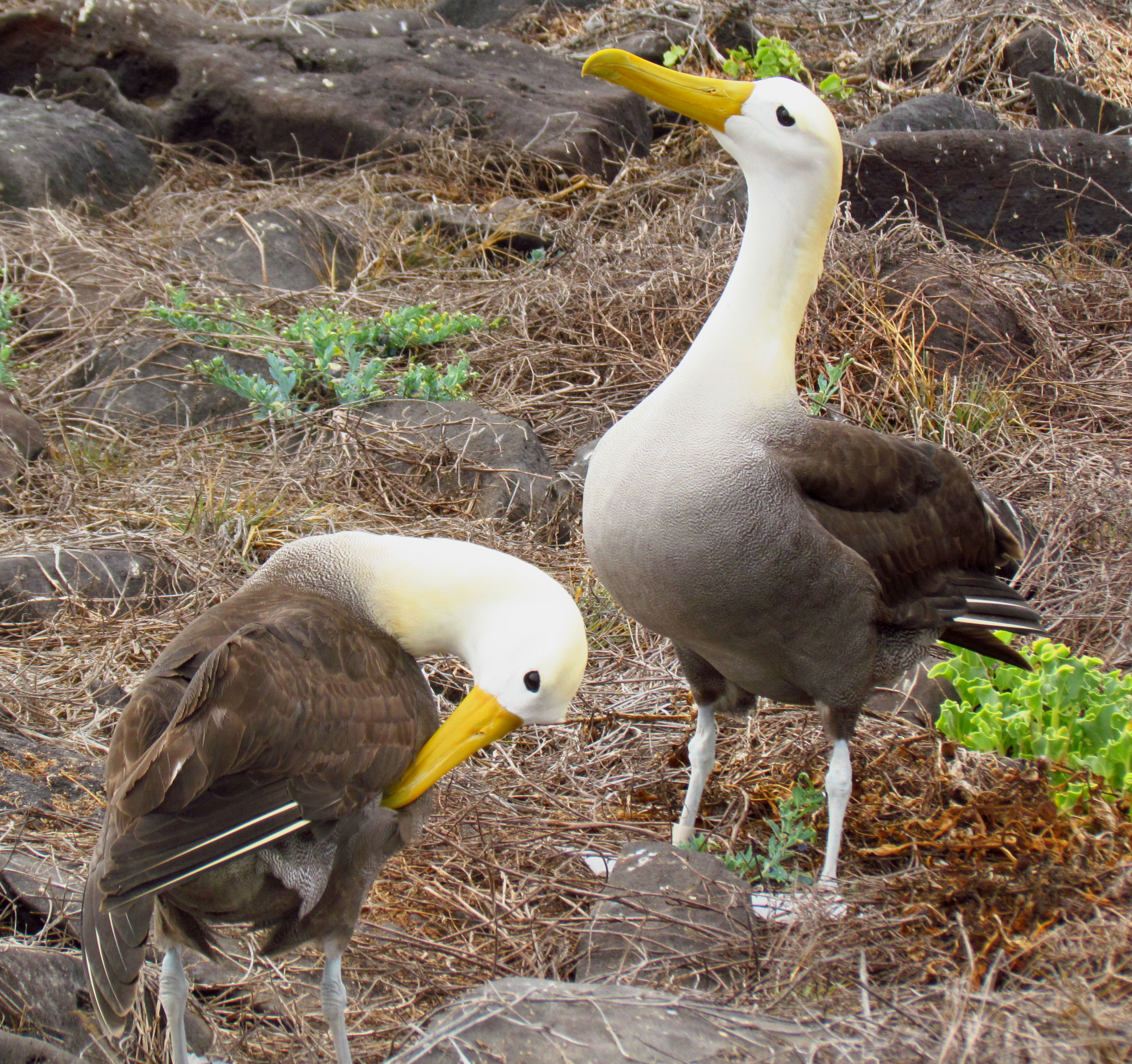
Waved Albatross
Phoebastria irrorata
Photo: Wikimedia Commons (CC) via https://en.wikipedia.org/wiki/Waved_albatross
Overview
The waved albatross, also known as Galapagos albatross, is one of three species of the family Diomedeidae that occur in the tropics. When they forage, they follow a straight path to a single site off the coast of Peru, about 1,000 km (620 mi) to the east. During the non-breeding season, these birds reside primarily on the Ecuadorian and Peruvian coasts.
The Waved Albatross faces severe threats from fisheries bycatch, particularly in longline and gillnet operations throughout its foraging range along the coasts of Peru, Ecuador, and Colombia. Climate change and El Niño events disrupt marine food webs, reducing prey availability and forcing birds to travel greater distances to find food. Introduced species on Española Island, including goats and cats, have historically degraded nesting habitat and preyed on eggs and chicks, though control efforts have reduced these impacts.
Habitat
The Waved Albatross breeds exclusively on Española Island in the Galápagos, nesting on rocky coastal areas and cliff tops with sparse vegetation. During the non-breeding season, it ranges widely across the eastern Pacific Ocean, foraging in productive upwelling waters along the coasts of Peru, Ecuador, and northern Chile.
Conservation measures underway
Other threatened species in DIOMEDEIDAE
Threatened in Chile
Frequently asked questions
Why is Waved Albatross classified as Critically Endangered?
Where does Waved Albatross live?
What are the main threats to Waved Albatross?
Get weekly conservation intelligence
One short digest a week of the most striking species and country data we ship, plus breaking conservation news paired with our database where it matters.
Free, no spam. One-click unsubscribe in every email.