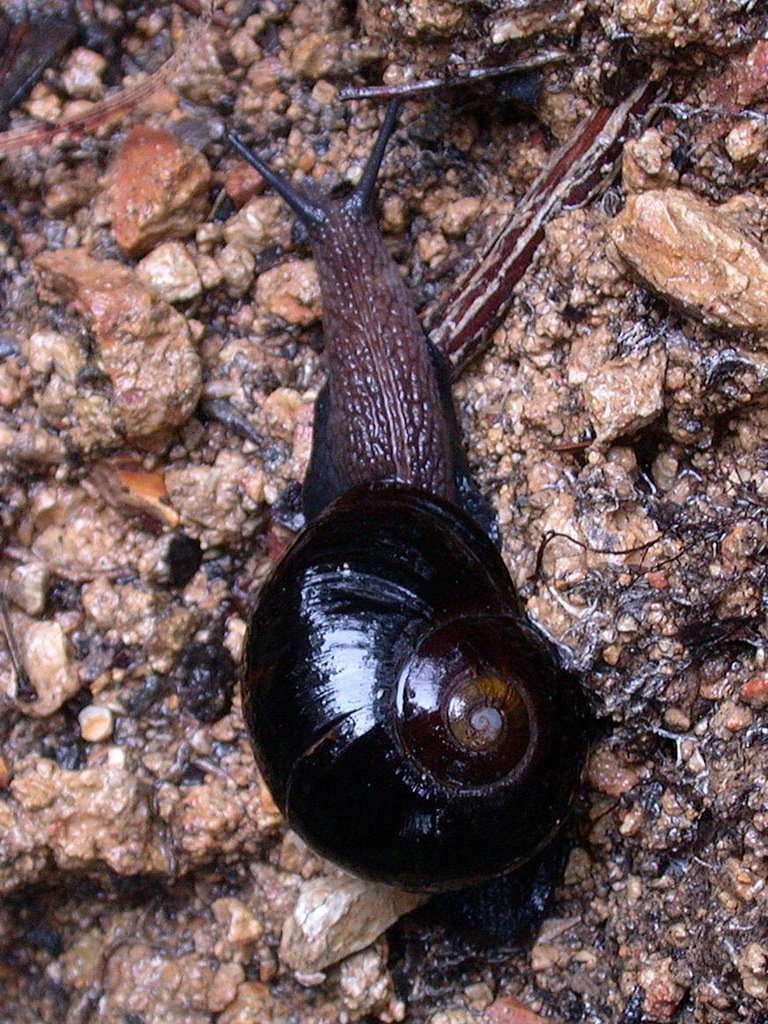
Victaphanta compacta
Photo: Wikimedia Commons (CC) via https://en.wikipedia.org/wiki/Victaphanta_compacta
Overview
Victaphanta compacta is a large predatory land snail belonging to the family Rhytididae, a group of carnivorous gastropods native to Australia and New Zealand. It possesses a robust, coiled shell and feeds on earthworms, slugs, and other soft-bodied invertebrates, making it a significant invertebrate predator within its native leaf-litter ecosystem. Like other rhytidids, it is nocturnal and relies on consistently moist, sheltered microhabitats to avoid desiccation, emerging to forage after rain or during humid conditions.
The species is restricted to forested habitats in Australia, where it depends on intact, moisture-retaining leaf litter and understory vegetation. Its terrestrial habitat requirements make it highly sensitive to changes in canopy cover, soil moisture, and ground-level vegetation structure.
Victaphanta compacta is classified as Endangered, with population trends currently unknown due to limited monitoring data. Its primary threats stem from agricultural expansion and land conversion, which directly destroy suitable habitat, alongside urban and residential development that fragments remaining forest patches. Introduced mammalian predators, particularly rats and hedgehogs, prey directly on the snails, while invasive plant species alter the understory composition it depends on for shelter and humidity.
Forest fragmentation further isolates populations, reducing genetic exchange and increasing vulnerability to local extinction.
Conservation efforts for this species are generally embedded within broader Australian forest habitat protection and invasive species control programs, including predator management targeting introduced mammals and revegetation initiatives aimed at restoring native understory. Species-specific monitoring and dedicated recovery actions remain limited.
Given ongoing habitat fragmentation, ongoing predation pressure, and the absence of robust population data, the species' long-term outlook remains uncertain, with continued vulnerability expected unless habitat protection and predator control measures are strengthened and sustained.
Victaphanta compacta, a land snail, is losing its forest home as land is cleared for farming and housing, leaving the remaining patches of forest small and disconnected. It also faces being eaten by introduced predators like rats and hedgehogs, while invasive plants are changing the forest floor plants it depends on. These pressures all appear to be ongoing and active, suggesting the threats are currently stable rather than easing.
Habitat
This endemic New Zealand land snail inhabits native forest understory, particularly in areas with dense leaf litter and rotting logs that provide shelter and feeding opportunities. The species requires moist, shaded environments with stable microclimates found in mature native forest remnants.
Other threatened species in RHYTIDIDAE

Threatened in Australia
Frequently asked questions
Why is Victaphanta compacta classified as Endangered?
Where does Victaphanta compacta live?
What are the main threats to Victaphanta compacta?
Get weekly conservation intelligence
One short digest a week of the most striking species and country data we ship, plus breaking conservation news paired with our database where it matters.
Free, no spam. One-click unsubscribe in every email.