
Himalayan Salamander
Tylototriton himalayanus
Photo: Wikimedia Commons (CC) via https://en.wikipedia.org/wiki/Tylototriton_himalayanus
Overview
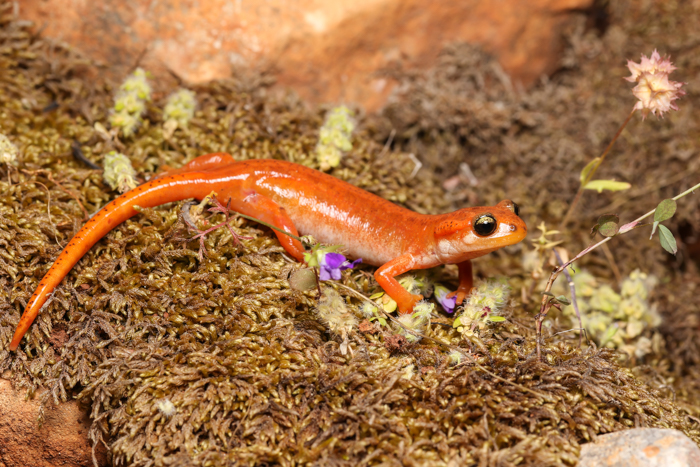
The Himalayan newt is a robust salamander species characterized by its distinctive orange-red coloration along the vertebral ridge and tail, contrasting with its dark brown to black body. Adults typically measure 12-15 centimeters in length and possess prominent parotoid glands behind their heads. These semi-aquatic amphibians play a crucial role in their ecosystems as both predators of invertebrates and prey for larger vertebrates, helping maintain ecological balance in their montane environments.
This species inhabits the Himalayan region across Myanmar, Bhutan, India, and Nepal, typically found at elevations between 1,500-3,000 meters. Himalayan newts prefer cool, moist environments including forest streams, ponds, and surrounding terrestrial areas with dense vegetation cover.
The species faces multiple ongoing threats contributing to its Vulnerable status and declining population trend. Agricultural expansion, particularly non-timber crop cultivation, is fragmenting and destroying critical habitat. Logging operations continue to degrade forest ecosystems essential for the species' survival.
Recreational activities in mountain regions create disturbance and habitat degradation. Climate change is causing habitat shifting and alteration, potentially pushing suitable conditions beyond the species' adaptive capacity. Additionally, invasive species and diseases pose emerging threats to native populations.
Conservation efforts remain limited, with most protection occurring within existing protected areas across the species' range. Research initiatives are working to better understand population dynamics and habitat requirements.
The current outlook remains concerning, with continued habitat loss and climate pressures likely to further reduce populations without enhanced conservation intervention and habitat protection measures.
The Himalayan newt faces multiple ongoing threats to its survival, including the clearing of forests for logging and crop farming, as well as damage from recreational activities in its natural habitat. The species is also threatened by invasive diseases and non-native species that disrupt its ecosystem, along with broader changes to its environment that alter the conditions it needs to survive. All of these threats are currently ongoing and appear to be stable rather than increasing or decreasing.
Conservation measures underway
Other threatened species in SALAMANDRIDAE
Threatened in Bhutan


Frequently asked questions
Why is Himalayan Salamander classified as Vulnerable?
Where does Himalayan Salamander live?
What are the main threats to Himalayan Salamander?
Get weekly conservation intelligence
One short digest a week of the most striking species and country data we ship, plus breaking conservation news paired with our database where it matters.
Free, no spam. One-click unsubscribe in every email.