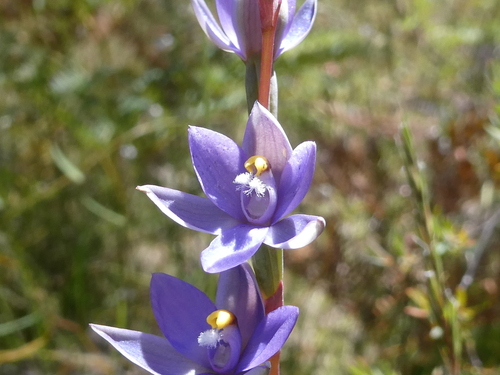
Blue Star Sun-orchid
Thelymitra hygrophila
Photo: Photo: (c) Rod Seager, some rights reserved (CC BY-NC), uploaded by Rod Seager
Overview
This terrestrial orchid produces a single erect flowering stem topped with distinctive blue, star-shaped flowers that open fully only in warm, sunny conditions, a characteristic typical of the genus Thelymitra. Like other sun-orchids, it relies on a single thin leaf for photosynthesis during the growing season and depends on specific soil fungi (mycorrhizae) to germinate and survive. As with many orchids, it likely offers little nectar reward and may rely on deceptive pollination strategies, attracting native bees through mimicry rather than food offerings.
Its ecological role centers on this specialized fungal partnership and its interaction with pollinators within damp, low-lying plant communities.
The species is restricted to Australia, where it grows in moist habitats including forest margins, and areas near permanent rivers, streams, and freshwater lakes. Its dependence on consistently damp soils makes it vulnerable to changes in local hydrology.
Its critically endangered status stems from a combination of pressures: land conversion for wood and pulp plantations, livestock grazing, and urban expansion have reduced and fragmented suitable habitat. Altered water management and dams disrupt the wetland hydrology it depends on, while drought conditions compound moisture stress. Inappropriate fire regimes, invasive species, and disturbance from feral animals further degrade remaining populations.
Conservation efforts typical for threatened Australian terrestrial orchids include habitat protection within reserves, monitoring of known populations, and research into mycorrhizal associations to support propagation and potential translocation programs. Seed banking and ex-situ cultivation are commonly employed for related sun-orchid species facing similar threats.
Given the ongoing and multiple concurrent threats affecting its limited habitat, the population trend remains decreasing, and the species' long-term survival depends on sustained habitat protection and hydrological management across its remaining range.
The Blue Star Sun-orchid faces habitat loss from land being cleared for tree plantations, livestock grazing, and housing development, along with changes to water flow from dams affecting the wet habitats it depends on. It is further threatened by invasive species, altered fire patterns, drought, and disturbance from hunting and harvesting activities in its habitat. These threats appear to be ongoing and stable rather than clearly increasing or decreasing.
Habitat
Conservation measures underway
Other threatened species in ORCHIDACEAE
Threatened in Australia
Frequently asked questions
Why is Blue Star Sun-orchid classified as Critically Endangered?
Where does Blue Star Sun-orchid live?
What are the main threats to Blue Star Sun-orchid?
Get weekly conservation intelligence
One short digest a week of the most striking species and country data we ship, plus breaking conservation news paired with our database where it matters.
Free, no spam. One-click unsubscribe in every email.