Tenkile
Dendrolagus scottae
Overview
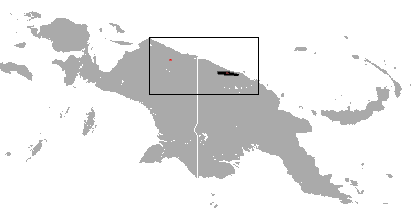
The Tenkile, or Scott's tree kangaroo (Dendrolagus scottae), is one of the world's rarest marsupials, confined to the cloud-shrouded forests of the Torricelli Mountain Range in Papua New Guinea's West Sepik Province. This stocky, muscular tree kangaroo is covered in dense, dark chocolate-brown to blackish fur that sheds rain in its perpetually damp montane habitat, with a lighter buff-colored belly and small rounded ears partially hidden in thick fur. Adapted for an arboreal lifestyle, it has powerful hindlimbs, strong curved claws, and a long tail used for balance as it moves through the forest canopy, though it also spends considerable time foraging on the ground for leaves, fruit, ferns, and bark.
The species is classified as Critically Endangered (CR) by the IUCN, with its entire known range restricted to roughly 120,000 hectares of highland rainforest between 1,000 and 2,000 meters elevation. Historically decimated by subsistence hunting with dogs, the Tenkile's population fell to an estimated 100 individuals or fewer by the late 1990s before targeted conservation intervention began. Encouragingly, the population trend is now considered stable, a direct result of the Tenkile Conservation Alliance's work with local communities, which has combined hunting moratoriums, alternative protein programs, and environmental education to reduce pressure on the species.
This partnership between villagers and conservationists stands as a notable example of community-led recovery for a species that came perilously close to extinction. Despite this progress, the Tenkile remains highly vulnerable due to its extremely restricted range, low reproductive rate, and continued reliance on intact montane forest that faces potential future pressure from logging and agricultural expansion.
The Tenkile's historic decline was driven primarily by intensive subsistence hunting with trained dogs, which is especially effective against this slow-reproducing, ground-foraging tree kangaroo. Its extremely restricted range within the Torricelli Mountains leaves the entire population exposed to localized threats such as forest clearance for shifting agriculture. Although community-based hunting bans have stabilized numbers, the species' single-population structure and low genetic diversity continue to make it highly susceptible to any resurgence in hunting pressure or habitat disturbance.
Habitat
The Tenkile inhabits mid- to high-elevation cloud forest between 1,000 and 2,000 meters in the Torricelli Mountain Range of Papua New Guinea, relying on continuous canopy cover and a mix of ground and arboreal foraging grounds within this narrow, restricted range.
Conservation measures underway
Other threatened species in MACROPODIDAE


Threatened in Papua New Guinea
Frequently asked questions
Why is Tenkile classified as Critically Endangered?
Where does Tenkile live?
What are the main threats to Tenkile?
Get weekly conservation intelligence
One short digest a week of the most striking species and country data we ship, plus breaking conservation news paired with our database where it matters.
Free, no spam. One-click unsubscribe in every email.