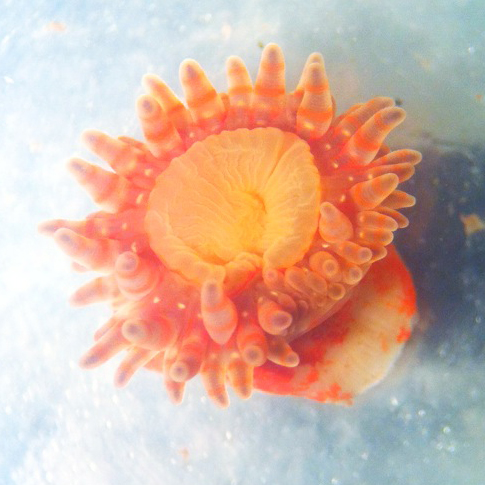
Scarlet Sea Anemone
Stomphia coccinea
Photo: Wikimedia Commons (CC) via https://en.wikipedia.org/wiki/Stomphia_coccinea
Overview
Stomphia coccinea is a solitary, soft-bodied anthozoan notable for its striking red to orange coloration and its unusual capacity for locomotion. Unlike most sea anemones, which remain fixed to a substrate for life, this species can detach its pedal disc and swim in a rhythmic, twisting motion when threatened, particularly in response to contact with certain predatory sea stars. It typically attaches to rocks, shells, or other hard surfaces on the seafloor, where it uses its ring of tentacles to capture small invertebrates and drifting prey, playing a role as both predator and prey within benthic marine food webs and offering microhabitat structure for small associated organisms.
The species has a wide circumpolar and temperate distribution, occurring in cold, marine waters across the North Atlantic and North Pacific, including the coasts of Canada, the United States, Greenland, Iceland, Norway, Svalbard, Russia, Japan, South Korea, and several European nations, with additional records extending to Australia and Mexico. It inhabits subtidal and deeper marine benthic zones.
No population figures are available, and the population trend is currently unknown. The species is classified as Vulnerable, with threats including bottom trawling that physically destroys seafloor habitat, ocean acidification and warming that affect prey availability and current patterns, coastal pollution, and overfishing that depletes prey fish populations.
Targeted conservation measures specific to this species are not well documented, though it may benefit indirectly from broader marine protected areas, fisheries regulations, and international efforts to curb ocean acidification and pollution. Given the combination of ongoing, compounding threats and the absence of clear population data, its long-term outlook remains uncertain.
The Scarlet Sea Anemone faces damage to its seafloor habitat from bottom trawling fishing gear, along with pollution flowing in from coastal construction and development. It's also struggling with the broader effects of climate change, including shifting ocean currents, warming waters, and more acidic seawater, all of which can reduce the small fish and prey it depends on for food. These threats are currently ongoing and show no signs of easing.
Habitat
Swimming Anemones inhabit rocky substrates and hard surfaces in cold North Atlantic waters, typically at depths of 10-200 meters. They attach to rocks, shells, and other sessile organisms in areas with strong currents that provide abundant planktonic food sources.
Other threatened species in Actinostolidae

Threatened in Australia
Frequently asked questions
Why is Scarlet Sea Anemone classified as Vulnerable?
Where does Scarlet Sea Anemone live?
What are the main threats to Scarlet Sea Anemone?
Get weekly conservation intelligence
One short digest a week of the most striking species and country data we ship, plus breaking conservation news paired with our database where it matters.
Free, no spam. One-click unsubscribe in every email.