Smoothback Guitarfish
Rhinobatos lionotus
Red List category history
- 2009DDData Deficient
- 2021–2024 · latestCRCritically Endangered
Years are assessment publication years. A change of category can reflect new information or revised taxonomy as well as a change in status. Source: IUCN Red List of Threatened Species, global assessment history. All category changes
Overview
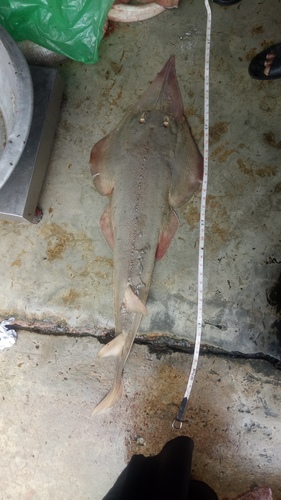
The smoothback guitarfish (Rhinobatos lionotus) is a little-studied ray-like elasmobranch belonging to the guitarfish family, named for its flattened, guitar-shaped body that blends the characteristics of sharks and rays. It has a pointed snout, a smooth dorsal surface lacking the thorny ridges seen in related species, and a sandy to grayish coloration that provides camouflage against seafloor sediments. This species inhabits shallow coastal and estuarine waters of the northern Indian Ocean, particularly along the coasts of Pakistan and India, where it forages over soft sandy and muddy bottoms for small fish, crustaceans, and mollusks.
The species is classified as Critically Endangered (CR) by the IUCN, reflecting a severe and ongoing population decline driven primarily by its occurrence in one of the world's most heavily fished marine regions. Guitarfishes like R. lionotus are especially vulnerable because their flattened bodies and bottom-dwelling habits make them highly susceptible to capture in trawl and gillnet fisheries operating throughout their limited coastal range.
Compounding this pressure, the species' biology—slow growth, late maturity, and low reproductive output—limits its capacity to recover from sustained fishing mortality. Coastal habitat degradation from industrial development and pollution further reduces available nursery and foraging grounds. On a more encouraging note, increasing regional recognition of guitarfish and wedgefish declines has spurred interest in bycatch mitigation measures and species-specific monitoring in parts of South Asia, and inclusion of related guitarfishes under international trade protections has raised the profile of this group among regional fisheries managers.
Continued investment in catch documentation and habitat protection in the northern Indian Ocean will be essential to prevent further decline of this Critically Endangered species.
Rhinobatos lionotus faces severe population declines primarily due to intensive fishing pressure across its range in the Western Indian Ocean. The species is particularly vulnerable to bottom trawling and gillnet fisheries that target demersal species in coastal waters. Habitat degradation from coastal development and pollution further compounds these pressures, while the species' slow reproductive rate limits its ability to recover from fishing mortality.
Habitat
This guitarfish inhabits shallow coastal waters, sandy and muddy bottoms, and continental shelf areas in the Western Indian Ocean. It typically occurs in depths ranging from nearshore waters to approximately 200 meters, preferring soft substrates where it can bury itself for camouflage and feeding.
Conservation measures underway
Other threatened species in RHINOBATIDAE
Threatened in Bangladesh



Frequently asked questions
Why is Smoothback Guitarfish classified as Critically Endangered?
Where does Smoothback Guitarfish live?
What are the main threats to Smoothback Guitarfish?
Get weekly conservation intelligence
One short digest a week of the most striking species and country data we ship, plus breaking conservation news paired with our database where it matters.
Free, no spam. One-click unsubscribe in every email.