
Long-nosed Crocodile
Gavialis gangeticus
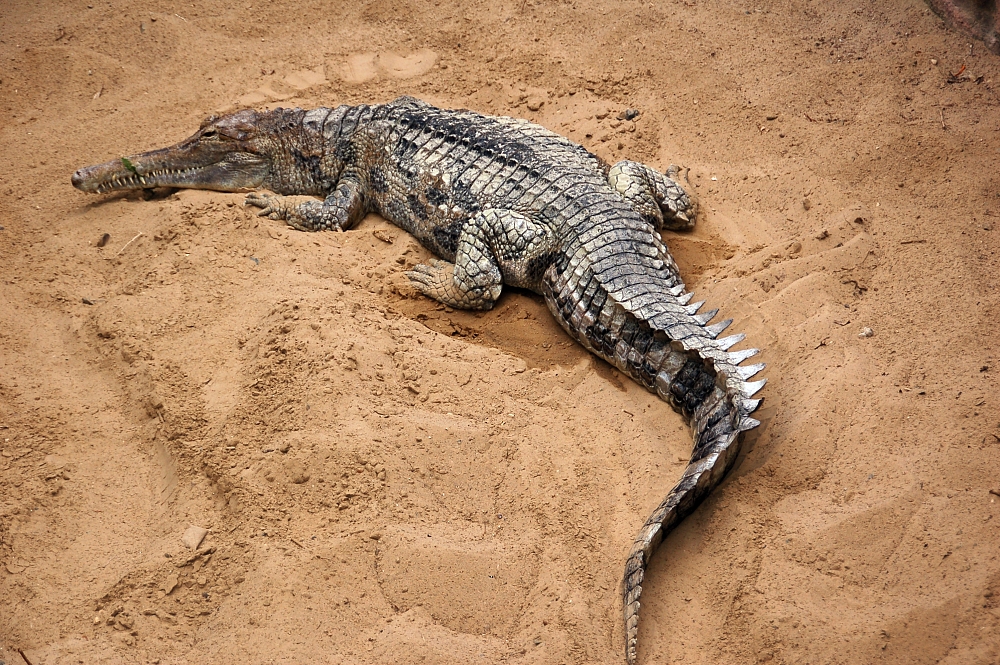
Photo: Wikimedia Commons (CC) via https://en.wikipedia.org/wiki/Gharial
Overview
The gharial, also known as gavial or fish-eating crocodile, is a crocodilian in the family Gavialidae and among the longest of all living crocodilians. Mature females are 2.6 to 4.5 m long, and males 3 to 6 m. Adult males have a distinct boss at the end of the snout, which resembles an earthenware pot known as a ghara, hence the name "gharial". The gharial is well adapted to catching fish because of its long, narrow snout and 110 sharp, interlocking teeth.
The gharial (Gavialis gangeticus) has experienced catastrophic population declines of over 95% since the 1940s, primarily due to extensive habitat loss and degradation of river systems. Dam construction, sand mining, fishing activities, and water extraction have severely fragmented and altered the free-flowing river habitats essential for this critically endangered crocodilian. Egg collection, accidental capture in fishing nets, and pollution further compound the species' precarious situation.
Habitat
The gharial once thrived in all the major river systems of the northern Indian subcontinent, from the Indus River in Pakistan, the Ganges in India, the Brahmaputra River in northeastern India and Bangladesh to the Irrawaddy River in Myanmar. By the early 1980s, it was almost extinct in the Indus. It was considered extinct in the Koshi River since 1970. In the 1940s, it was numerous in the Barak...
Conservation measures underway
Other threatened species in GAVIALIDAE
Threatened in Bangladesh



Frequently asked questions
Why is Long-nosed Crocodile classified as Critically Endangered?
Where does Long-nosed Crocodile live?
What are the main threats to Long-nosed Crocodile?
Get weekly conservation intelligence
One short digest a week of the most striking species and country data we ship, plus breaking conservation news paired with our database where it matters.
Free, no spam. One-click unsubscribe in every email.