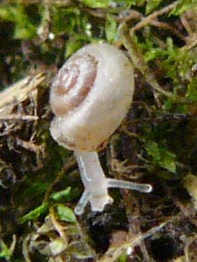
Smooth Grass Snail
Vallonia pulchella
Photo: Wikimedia Commons (CC) via https://en.wikipedia.org/wiki/Vallonia_pulchella
Overview
Vallonia pulchella is a minute land snail, with an adult shell typically measuring only 2 to 2.5 millimeters in diameter, characterized by a flattened, disc-like spiral form and a thin, translucent, glossy shell. Like other members of the Valloniidae, it is a detritivore, feeding on decaying plant matter, algae, and fungal material, and in doing so contributes to nutrient cycling and soil formation in the habitats it occupies. It moves little over its lifetime and is often found clustered in leaf litter, moss, or loose soil, particularly in calcium-rich substrates that support shell development.
This species has an extraordinarily broad distribution, recorded across Europe, parts of Asia, North Africa, the Americas, Oceania, and numerous island territories, reflecting both natural range and likely human-assisted dispersal. It occupies terrestrial habitats such as grasslands, hedgerows, calcareous soils, and disturbed ground with adequate moisture and lime content.
Despite its wide range, the species faces consistent pressure from agricultural intensification and pesticide use, loss of calcareous grasslands, frequent mowing and intensive grassland management, habitat fragmentation from urban expansion, and shifting soil moisture patterns linked to climate change. These factors degrade the fine-scale microhabitats this snail depends upon.
No species-specific conservation programs are documented, though it may benefit incidentally from broader habitat protections in calcareous grassland reserves and agri-environment schemes across parts of its European range. Population trends remain unknown due to limited monitoring of small invertebrates like this one. Given its wide distribution but ongoing habitat degradation, its long-term outlook is uncertain, warranting closer population assessment.
The Smooth Grass Snail is mainly threatened by farming practices, including heavy pesticide use and the loss of natural grasslands as land is converted for intensive agriculture, along with urban development that breaks up its habitat into smaller, isolated patches. Frequent mowing of grasslands and changing soil moisture linked to climate change further reduce the quality of places where it can live. These pressures appear to be ongoing and stable rather than clearly worsening or improving.
Habitat
The Smooth Grass Snail inhabits short, dry calcareous grasslands, chalk downs, and limestone pavements across Europe. It requires well-drained soils with high calcium content and thrives in areas with sparse vegetation and exposed ground.
Threatened in Afghanistan

Frequently asked questions
Why is Smooth Grass Snail classified as Vulnerable?
Where does Smooth Grass Snail live?
What are the main threats to Smooth Grass Snail?
Get weekly conservation intelligence
One short digest a week of the most striking species and country data we ship, plus breaking conservation news paired with our database where it matters.
Free, no spam. One-click unsubscribe in every email.