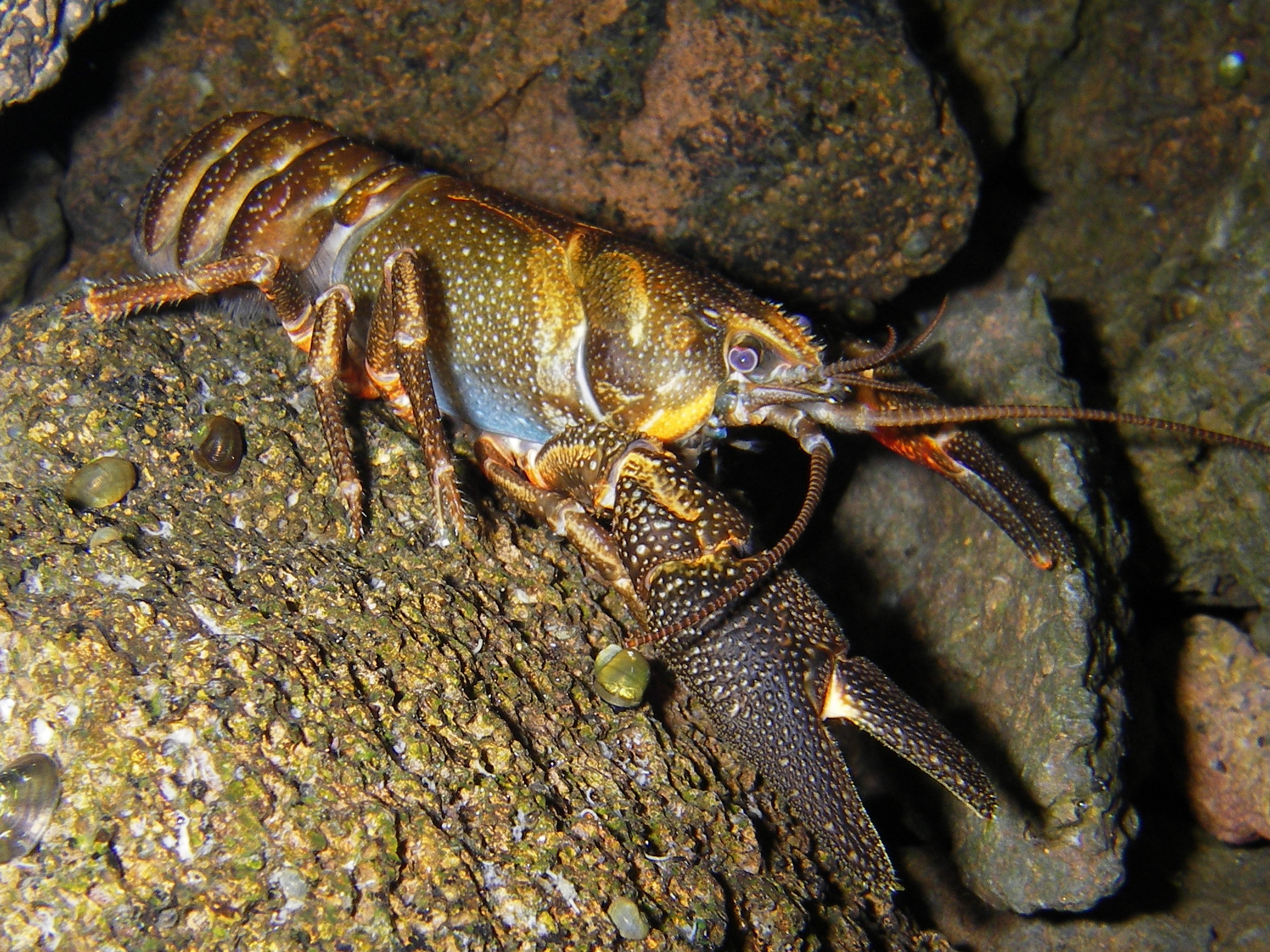
Pacifastacus fortis
Photo: Wikimedia Commons (CC) via https://en.wikipedia.org/wiki/Pacifastacus_fortis
Overview
Pacifastacus fortis is an endangered crayfish species endemic to Shasta County, California, where it is found and first described in 1914, only in isolated spots along the Pit River and Fall River Mills. It is estimated that there are a total of roughly 4000 of the species still alive today. The exact subpopulations for the Shasta crayfish were discovered in 2004 through a genetic study that determined three different genetic clusters: Crystal Lake, the Big Lake group, and Thousand Springs.
Pacifastacus fortis faces severe population decline primarily due to habitat degradation from agricultural runoff and urban development in its limited California range. Competition and disease transmission from introduced crayfish species, particularly the signal crayfish, pose additional threats to remaining populations. Water diversions and drought conditions have further reduced suitable habitat availability in the species' already restricted distribution.
Habitat
This freshwater crayfish inhabits cool, clear streams and rivers in the Sacramento-San Joaquin river system of California. It requires well-oxygenated waters with rocky substrates and riparian vegetation cover.
Conservation measures underway
Other threatened species in ASTACIDAE
Threatened in United States
Frequently asked questions
Why is Pacifastacus fortis classified as Critically Endangered?
Where does Pacifastacus fortis live?
What are the main threats to Pacifastacus fortis?
Get weekly conservation intelligence
One short digest a week of the most striking species and country data we ship, plus breaking conservation news paired with our database where it matters.
Free, no spam. One-click unsubscribe in every email.