Mountain Rush
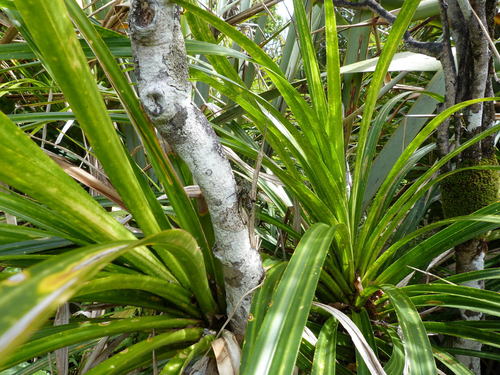
Freycinetia baueriana
Photo: (c) Colin Meurk, some rights reserved (CC BY-SA), uploaded by Colin Meurk
Overview
Freycinetia baueriana is a climbing, woody vine in the pandan family, characterised by long, strap-like leaves arranged in spirals along its stems and a scrambling habit that allows it to ascend host trees within the forest canopy. Like other members of its genus, it likely produces clustered inflorescences surrounded by fleshy bracts, a structure typically associated with pollination by birds or invertebrates in Pandanaceae, and its fruiting bodies contribute to forest food webs by providing resources for seed-dispersing fauna. As a climbing vine, it also plays a structural role within the forest understory and canopy, occupying microhabitats that support broader plant and animal diversity.
This species is restricted to Norfolk Island, an external territory of Australia, where it inhabits native forest ecosystems. Its range is naturally limited by the island's small land area, and its persistence depends heavily on the condition of remaining forest fragments.
The species faces a convergence of pressures typical of small island endemics. Ongoing housing and urban expansion, residential and commercial development, and agricultural activities—including livestock ranching and non-timber crop cultivation—have reduced and fragmented available forest habitat. Invasive non-native species threaten it through competition, habitat alteration, or predation on pollinators, while climate change introduces additional stress through shifting weather patterns.
Its small population size further increases vulnerability to genetic bottlenecks and stochastic events.
Conservation attention on Norfolk Island includes habitat protection efforts and management of invasive species within reserves, though detailed population figures are not established. Given the compounding threats and its restricted range, the species' outlook remains precarious, with a continuing decreasing population trend and no clear indication of stabilisation without sustained habitat protection and invasive species control.
Mountain Rush is losing its natural habitat as land is cleared for housing, farms, crops, and livestock grazing, while people harvesting resources from the wild add further pressure. It also faces competition from invasive plants and animals that crowd out native species, and its small remaining population makes it especially vulnerable to inbreeding problems and unpredictable weather linked to climate change. Overall, these combined pressures appear to be ongoing and stable rather than clearly worsening, though the small population size remains a serious long-term concern.
Habitat
This endemic climbing vine inhabits the remaining native forests of Norfolk Island, typically growing as an epiphyte or climbing plant in subtropical rainforest remnants. It requires mature forest canopy for support and is found in areas with high humidity and consistent moisture levels.
Conservation measures underway
Other threatened species in PANDANACEAE
Threatened in Australia
Frequently asked questions
Why is Mountain Rush classified as Critically Endangered?
Where does Mountain Rush live?
What are the main threats to Mountain Rush?
Get weekly conservation intelligence
One short digest a week of the most striking species and country data we ship, plus breaking conservation news paired with our database where it matters.
Free, no spam. One-click unsubscribe in every email.