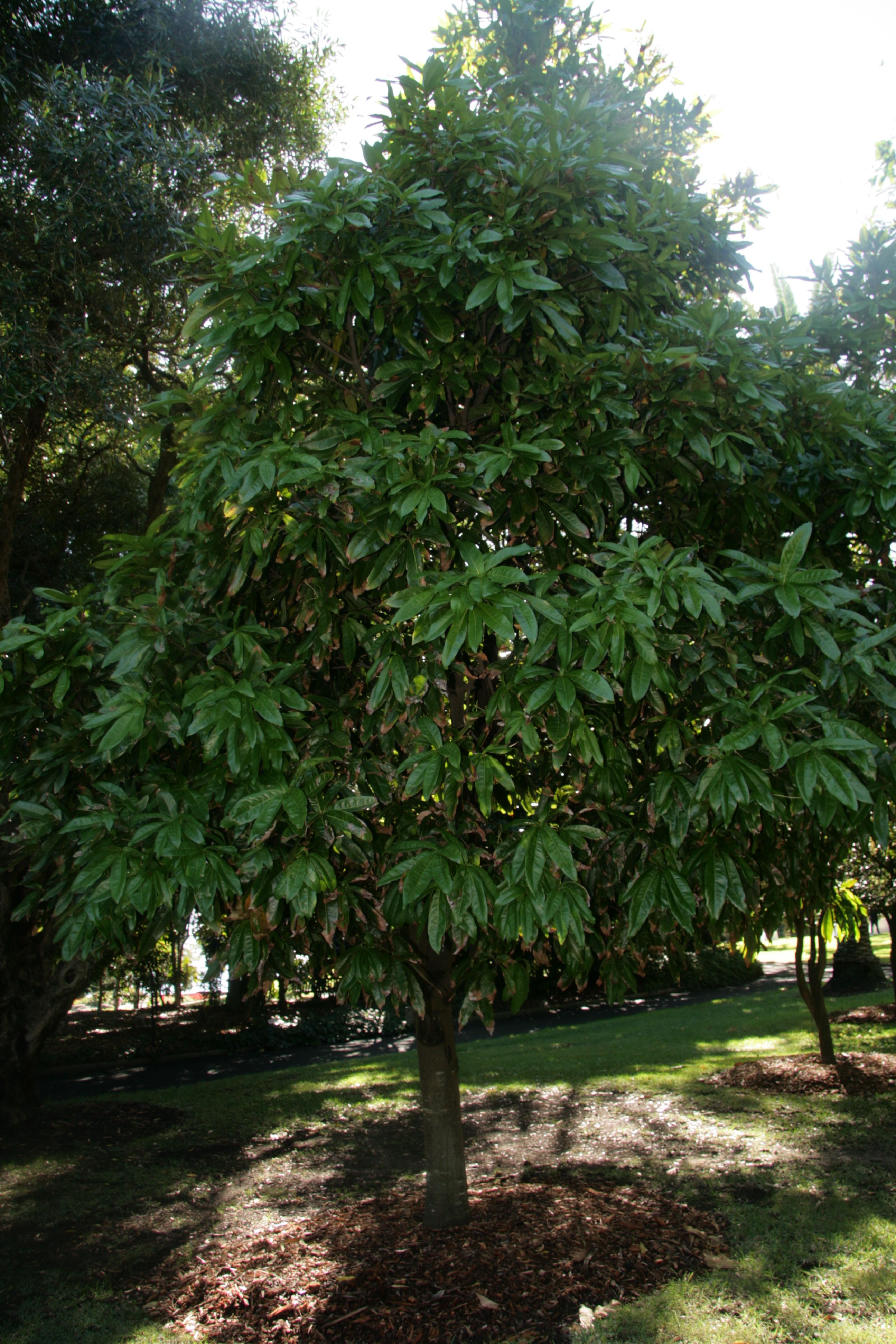
Lasjia grandis
Photo: Wikimedia Commons (CC) via https://en.wikipedia.org/wiki/Lasjia_grandis
Overview
This large-leaved evergreen tree belongs to the Proteaceae family, a lineage best known for its association with macadamia nuts, and Lasjia grandis shares the family's characteristic hard-shelled fruit structure. It grows as a canopy or sub-canopy tree in rainforest settings, producing clusters of cream to yellowish flowers followed by woody, rounded fruits containing a single large seed. As with other Proteaceae, its flowers likely attract insects and other pollinators, while its seeds provide a food source for rainforest fauna capable of breaking through the tough pericarp.
Within its ecosystem, the species contributes to the structural complexity of the forest canopy and supports the broader web of rainforest biodiversity typical of tropical lowland forests.
The species is restricted to Australia, where it occurs in subtropical and tropical moist lowland forest. Its distribution is naturally limited, a characteristic shared by many Proteaceae endemic to Australian rainforest refugia.
Lasjia grandis is classified as Endangered, primarily due to ongoing logging and wood harvesting, which reduces available habitat and fragments remaining populations. Invasive non-native species and associated diseases pose an additional ongoing threat, potentially affecting seedling establishment, tree health, or ecosystem interactions the species depends on.
Conservation attention for the species stems largely from its Red List assessment, which flags the need for habitat protection and monitoring given its restricted range. Management of remaining lowland rainforest tracts in Australia, including efforts to control invasive species, indirectly benefits this tree.
Population trends are currently assessed as stable, suggesting that immediate decline has been arrested, though the species remains vulnerable given its limited distribution and the continuing presence of logging and invasive species pressures within its habitat.
Lasjia grandis is primarily threatened by ongoing logging and timber harvesting, which removes and damages the trees in its forest habitat. It also faces pressure from invasive non-native species, which can compete with or otherwise harm the plant. Both threats are currently classified as ongoing, indicating a stable but continuing level of risk rather than a clear increase or decrease.
Habitat
Conservation measures underway
Other threatened species in PROTEACEAE
Threatened in Australia
Frequently asked questions
Why is Lasjia grandis classified as Endangered?
Where does Lasjia grandis live?
What are the main threats to Lasjia grandis?
Get weekly conservation intelligence
One short digest a week of the most striking species and country data we ship, plus breaking conservation news paired with our database where it matters.
Free, no spam. One-click unsubscribe in every email.