thelopsis lichen
Thelopsis rubella
Overview
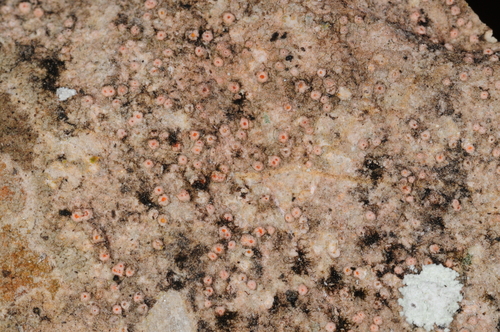
Thelopsis rubella is a crustose lichen in the family Stictidaceae, forming thin, inconspicuous thalli on bark. Like other Ostropales, it reproduces via spores released from small fruiting bodies (apothecia) embedded in or raised slightly above its surface. As a lichen, it represents a symbiotic partnership between a fungal partner and a photosynthetic organism, and it contributes to nutrient cycling and micro-habitat structure on the trees it colonizes.
Lichens of this type are often used by ecologists as bioindicators, since their sensitivity to air quality and humidity reflects broader forest ecosystem health.
The species has a wide but scattered distribution across Europe, extending from Scandinavia and the British Isles through Central and Southern Europe into the Balkans, the Caucasus, and parts of Russia and Ukraine, with additional occurrences recorded in the United States, Brazil, and Australia. It is restricted to terrestrial habitats, typically old-growth or long-established woodlands where stable microclimates and undisturbed bark surfaces persist.
Its listing as Vulnerable reflects several converging pressures: atmospheric nitrogen deposition and industrial emissions alter the chemistry of tree bark substrates on which it depends; climate change is shifting humidity regimes necessary for its growth; and habitat fragmentation, along with urban development, is reducing the extent of mature forest stands available for colonization.
Conservation measures rely mainly on the broader protection of old-growth forest habitats and air quality regulations in some range countries, though species-specific action is limited. Population trends remain unknown due to insufficient monitoring data. Given ongoing habitat loss and pollution pressures across its range, the species' long-term outlook remains uncertain without more targeted forest conservation and air quality improvements.
Thelopsis rubella is mainly threatened by pollution from the air, including nitrogen from farming and industry, which changes the chemistry of the tree bark it needs to grow on. It also faces problems from old forests being cut into smaller, isolated patches and from cities and towns expanding into its habitat, leaving fewer suitable places for it to survive. Changing weather patterns are also affecting the humidity levels this lichen depends on. These combined pressures appear to be ongoing and intensifying rather than easing.
Habitat
Röd pysslinglav grows exclusively on the bark of old deciduous trees, particularly favoring smooth-barked species in humid, sheltered forest environments. The species requires stable microclimatic conditions with consistent moisture levels and minimal air pollution exposure.
Other threatened species in Stictidaceae
Threatened in Australia
Frequently asked questions
Why is thelopsis lichen classified as Vulnerable?
Where does thelopsis lichen live?
What are the main threats to thelopsis lichen?
Get weekly conservation intelligence
One short digest a week of the most striking species and country data we ship, plus breaking conservation news paired with our database where it matters.
Free, no spam. One-click unsubscribe in every email.