Uromenus riggioi
Overview
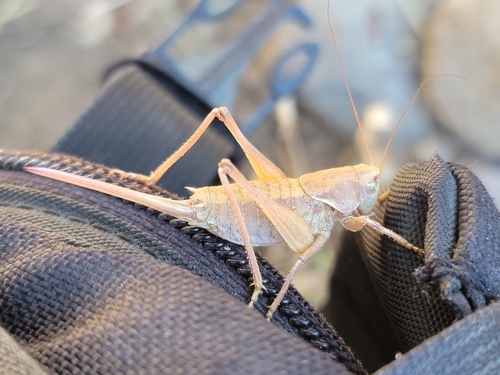
Uromenus riggioi is a bush-cricket (family Tettigoniidae) endemic to Sicily, Italy, where it survives in a small number of localized populations. Like other members of the genus Uromenus, it is a robust, flightless orthopteran with reduced wings, heavy hind legs adapted for jumping, and cryptic brown-green coloration that helps it blend into dry grassland and scrubland vegetation. It inhabits Mediterranean-type ecosystems characterized by seasonal aridity, sparse shrub cover, and open herbaceous patches, where it feeds on low vegetation and shelters among plant litter and rocky ground cover.
The species is classified as Critically Endangered (CR) on the IUCN Red List, with a decreasing population trend driven largely by the extreme restriction of its range and ongoing degradation of its Sicilian habitat. Agricultural intensification, urban expansion along the coast, and quarrying activity have fragmented and reduced the limited patches of suitable scrubland the species depends on, while its flightlessness severely limits its ability to disperse to new areas as habitat is lost. Because so few populations are known, localized events such as fire, drought, or land conversion pose a disproportionate risk to the species' overall survival.
Conservation attention for Sicilian endemic Orthoptera has been increasing, with entomological surveys helping to better define the species' distribution and inform habitat protection priorities on the island. Continued monitoring and legal protection of remaining scrubland fragments offer a genuine opportunity to stabilize remaining populations, and growing scientific interest in Sicily's endemic invertebrate fauna is a positive sign for future targeted conservation action.
Uromenus riggioi faces severe threats from habitat destruction due to agricultural expansion and urban development in its limited Mediterranean range. The species' extremely restricted distribution makes it particularly vulnerable to localized environmental changes and human activities. Climate change poses an additional threat through altered precipitation patterns and increased drought frequency in its specialized habitat.
Habitat
This critically endangered orthopteran inhabits dry Mediterranean scrubland and rocky grasslands with sparse vegetation. It requires specific microhabitat conditions including well-drained soils and particular plant associations typical of degraded Mediterranean ecosystems.
Conservation measures underway
Other threatened species in TETTIGONIIDAE
Threatened in Italy
Frequently asked questions
Why is Uromenus riggioi classified as Critically Endangered?
Where does Uromenus riggioi live?
What are the main threats to Uromenus riggioi?
Get weekly conservation intelligence
One short digest a week of the most striking species and country data we ship, plus breaking conservation news paired with our database where it matters.
Free, no spam. One-click unsubscribe in every email.