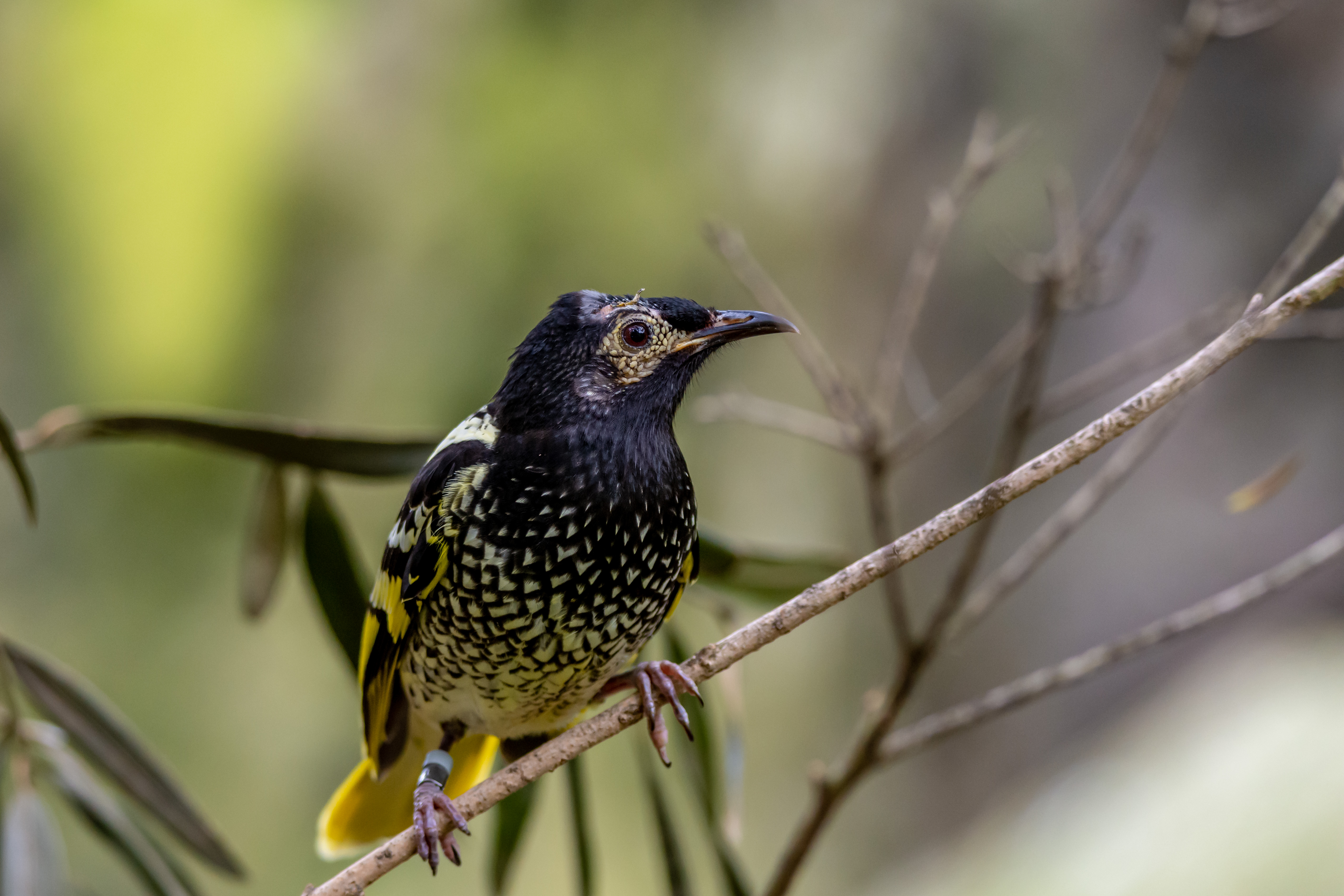
Regent Honeyeater
Anthochaera phrygia
Photo: Wikimedia Commons (CC) via https://en.wikipedia.org/wiki/Regent_honeyeater
Overview
A striking honeyeater with black-and-yellow plumage, distinctive bare pink facial skin, and a scalloped black-and-white breast pattern, this species is a specialist nectarivore that also feeds on insects and lerps. It plays an important ecological role as a pollinator of eucalypts and other flowering trees, and historically bred colonially, with individuals travelling widely in response to the unpredictable flowering patterns of box-ironbark woodlands.
Found only in southeastern Australia, its range once extended from southern Queensland through New South Wales into Victoria. Today confirmed breeding is largely restricted to a few areas including the Capertee Valley, Bundarra-Barraba region, and the Lower Hunter Valley, along with parts of north-central Victoria. It depends on temperate eucalypt woodlands and forests, particularly box-ironbark communities, as well as riparian corridors and wetland-adjacent vegetation used for foraging and movement.
Ongoing habitat loss from land clearing for housing, agriculture, and non-timber crop production has fragmented the woodlands this species relies on. Competition from aggressive native honeyeaters, which thrive in degraded and fragmented habitat, further reduces access to remaining resources. Invasive species, including introduced predators, add additional pressure on nests and young.
Conservation efforts include a long-running captive breeding and release program, habitat restoration and revegetation projects across key breeding regions, and nest monitoring and predator control at priority sites. Community and landholder engagement programs support woodland protection on private land, and research continues into the species' movement ecology to guide habitat connectivity planning.
The wild population is estimated at fewer than 300–400 mature individuals and continues to decline. Despite active intervention, the species remains at serious risk of extinction without sustained and expanded habitat protection and restoration.
The Regent Honeyeater is losing its habitat as land is cleared for housing developments and converted into farmland for crops like fruit and vegetables, leaving fewer trees for nesting and feeding. It also faces ongoing pressure from invasive species, which can compete with it for food and nesting sites or bring disease. These threats are ongoing and show no signs of easing, meaning the pressures on this bird's survival remain steady rather than improving.
Habitat
Conservation measures underway
Other threatened species in MELIPHAGIDAE
Threatened in Australia
Frequently asked questions
Why is Regent Honeyeater classified as Critically Endangered?
Where does Regent Honeyeater live?
What are the main threats to Regent Honeyeater?
Get weekly conservation intelligence
One short digest a week of the most striking species and country data we ship, plus breaking conservation news paired with our database where it matters.
Free, no spam. One-click unsubscribe in every email.