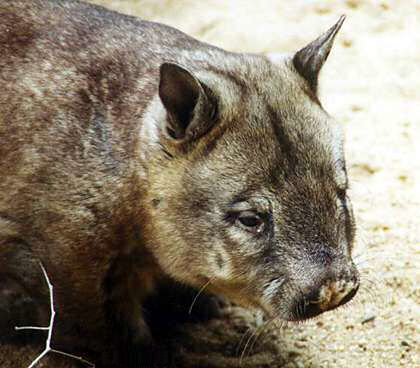
Northern Hairy-nosed Wombat
Lasiorhinus krefftii
Photo: Wikimedia Commons (CC) via https://en.wikipedia.org/wiki/Northern_hairy-nosed_wombat
Overview
One of the world's rarest large mammals, this heavily built, burrowing marsupial is covered in soft grey-brown fur, with a broad muzzle fringed by fine hairs, a large naked nose pad, and powerful claws adapted for digging extensive burrow systems. Nocturnal and largely solitary, individuals spend most daylight hours underground, emerging at night to graze on native grasses. Their burrowing activity aerates and turns over soil, influencing local vegetation structure and providing shelter used by other species.
The species is restricted to a single wild population in Epping Forest National Park in central Queensland, Australia, with an additional population established through translocation at Richard Underwood Nature Refuge. Its habitat centers on semi-arid grassland associated with inland wetland systems, particularly areas near permanent rivers and streams that support the deep, stable soils needed for burrow construction and reliable grass growth.
Historical range contraction was driven by competition with livestock for grazing land, alteration of fire regimes affecting grass availability, and predation pressure. Ongoing threats include continued impacts from cattle and sheep grazing on food resources, altered fire management, introduced predators and competing species, disease, and habitat degradation linked to past and present land use, including vegetation clearing.
Conservation efforts have included predator-proof fencing around core habitat, supplementary feeding during drought, translocation of individuals to establish a second, geographically separate population to reduce extinction risk from a single catastrophic event, and ongoing habitat and population monitoring.
The population is currently assessed as stable, reflecting the effectiveness of intensive, site-based management following the species' near-extinction in the twentieth century. Long-term security remains dependent on maintaining predator control, managing grazing pressure, and sustaining suitable habitat across both populations.
The Northern Hairy-nosed Wombat faces competition for grass and habitat damage from livestock grazing, along with risks from wildfires and past tree-clearing that have degraded its limited grassland habitat. It also faces pressure from invasive species and native wildlife (such as competition for food or predation), as well as other unspecified ongoing risks that threaten its already small, isolated population. These threats currently remain ongoing and stable rather than clearly increasing or decreasing.
Habitat
Conservation measures underway
Threatened in Australia
Frequently asked questions
Why is Northern Hairy-nosed Wombat classified as Critically Endangered?
Where does Northern Hairy-nosed Wombat live?
What are the main threats to Northern Hairy-nosed Wombat?
Get weekly conservation intelligence
One short digest a week of the most striking species and country data we ship, plus breaking conservation news paired with our database where it matters.
Free, no spam. One-click unsubscribe in every email.