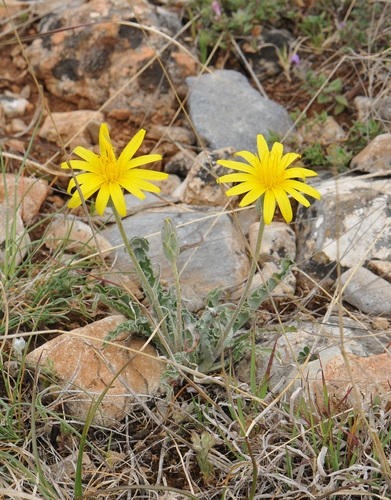
Ida's Salsify
Podospermum idae
Photo: Photo: (c) Todd Boland, some rights reserved (CC BY), uploaded by Todd Boland
Overview
Ida's Salsify (Podospermum idae) is a perennial flowering herb in the daisy family (Asteraceae), belonging to a genus known for its narrow, grass-like leaves and dandelion-like flower heads that open in the morning sun. As a member of the salsify group, it likely produces a solitary yellow composite flower atop a slender stem, with a taproot system adapted to dry, open ground. This species is classified as Critically Endangered (CR) by the IUCN, reflecting an extremely restricted distribution and a population under acute pressure.
Ida's Salsify is confined to a narrow geographic range, consistent with many localized Podospermum taxa that persist only in specific microhabitats such as calcareous grasslands, rocky slopes, or coastal scrub within a limited regional pocket of its native range. Its survival is threatened primarily by the small size and fragmentation of its habitat, which leaves the species highly vulnerable to localized disturbances such as land conversion, grazing pressure, and encroaching development. Because population trend data are currently unknown, monitoring gaps compound the conservation challenge, making it difficult to detect further declines before they become irreversible.
Despite these serious concerns, there is a meaningful positive note: increased botanical survey efforts across its native region have begun to document remaining subpopulations more precisely, providing a foundation for targeted habitat protection and seed banking initiatives. Regional herbaria and botanical gardens have shown growing interest in ex-situ conservation for narrow-range Mediterranean and West Asian endemics like this one, offering a safeguard against extinction while in-situ protections are developed. Continued field assessment, habitat designation, and community engagement in areas where the species occurs will be essential to reversing its precarious status and securing its long-term persistence in the wild.
Podospermum idae faces severe threats from habitat destruction due to urban development and agricultural expansion in its limited range. The species' extremely restricted distribution makes it particularly vulnerable to localized disturbances, while climate change poses additional risks through altered precipitation patterns affecting its specialized habitat requirements. Infrastructure development and quarrying activities have further fragmented the remaining populations.
Habitat
This critically endangered plant species inhabits rocky slopes, limestone outcrops, and dry grasslands in mountainous regions. It typically grows in well-drained, calcareous soils at moderate to high elevations where it has adapted to harsh, arid conditions.
Conservation measures underway
Other threatened species in ASTERACEAE
Frequently asked questions
Why is Ida's Salsify classified as Critically Endangered?
Where does Ida's Salsify live?
What are the main threats to Ida's Salsify?
Get weekly conservation intelligence
One short digest a week of the most striking species and country data we ship, plus breaking conservation news paired with our database where it matters.
Free, no spam. One-click unsubscribe in every email.