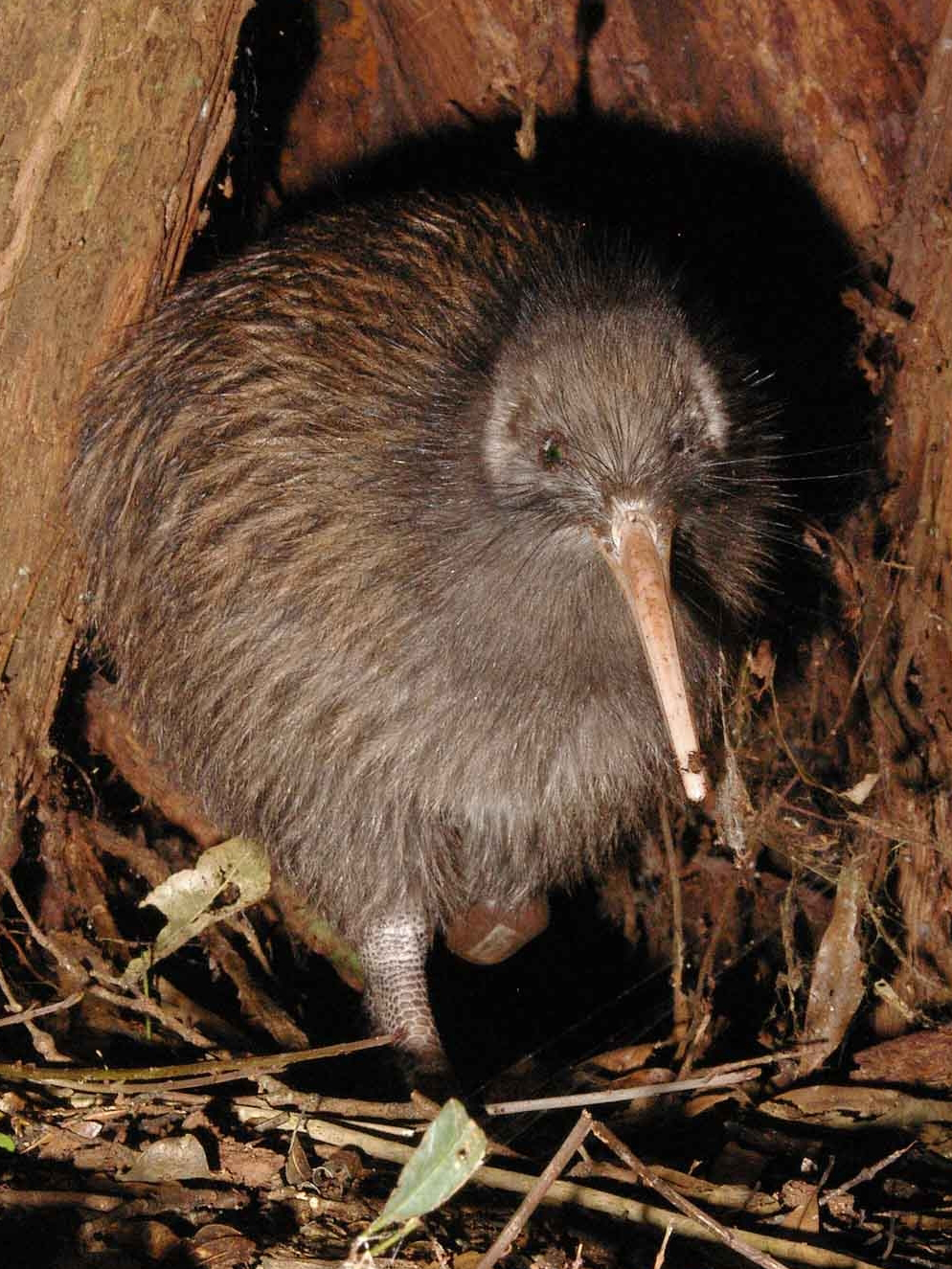
Apteryx mantelli
Photo: Wikimedia Commons (CC) via https://en.wikipedia.org/wiki/North_Island_brown_kiwi
Overview
Apteryx mantelli is a flightless, nocturnal bird endemic to New Zealand, recognizable by its hair-like brown feathers, long downward-curving bill with nostrils at the tip, and vestigial wings hidden beneath its plumage. It relies heavily on smell and touch rather than sight, using its bill to probe soil and leaf litter for invertebrates such as earthworms and insect larvae. As a ground-dwelling forager, it plays a role in soil aeration and invertebrate population regulation within its habitat.
Pairs are typically monogamous, and eggs are unusually large relative to body size, with males often taking the primary incubation role.
The species occupies forest and shrubland habitats across the North Island of New Zealand, and has also adapted to some modified, artificial terrestrial environments such as farmland with adequate cover. Populations have been reported in parts of Australia as well, likely through translocation or captive-management programs rather than natural range expansion.
The primary threat is predation by invasive mammalian species, particularly stoats, which prey on chicks, along with dogs and cats that kill both juveniles and adults. Habitat disturbance compounds these pressures in some areas, though the population trend is currently assessed as stable.
Conservation efforts include predator control and eradication programs, community-led trapping initiatives, and managed breeding-and-release schemes such as "Operation Nest Egg," where eggs or young chicks are raised in protected environments until large enough to withstand stoat predation before release into the wild.
Given ongoing predator management and habitat protection, the species' outlook remains cautiously stable, though continued vigilance against invasive predators is necessary to sustain current population levels and prevent future decline.
The main ongoing threat to this species is predation and other harmful impacts from animals and diseases introduced to areas outside their natural range, such as stoats, cats, and dogs that prey on birds and their eggs. These invasive predators pose a serious risk to survival, especially since native species often have no natural defenses against them. This threat is ongoing and shows no signs of decreasing.
Habitat
Conservation measures underway
Other threatened species in APTERYGIDAE


Threatened in Australia
Frequently asked questions
Why is Apteryx mantelli classified as Vulnerable?
Where does Apteryx mantelli live?
What are the main threats to Apteryx mantelli?
Get weekly conservation intelligence
One short digest a week of the most striking species and country data we ship, plus breaking conservation news paired with our database where it matters.
Free, no spam. One-click unsubscribe in every email.