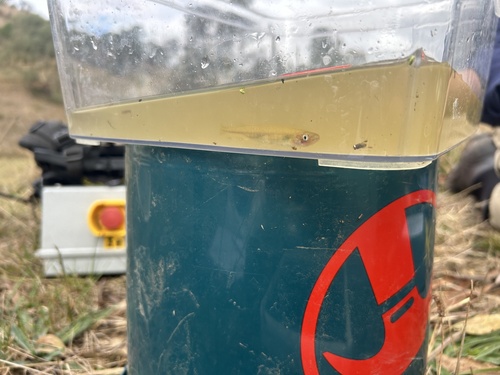
Flathead Galaxias
Galaxias rostratus
Photo: Photo: (c) fraserasquith, some rights reserved (CC BY-NC)
Overview
Galaxias rostratus is a small, elongate freshwater fish belonging to the family Galaxiidae, characterised by a scaleless body, a flattened head, and mottled olive-brown colouration that provides camouflage among aquatic vegetation and submerged debris. It is a slow-moving species that typically forages on small invertebrates and drifting organic matter, occupying a role as both predator of aquatic invertebrates and prey for larger fish and birds within its ecosystem. Little is documented about its specific reproductive behaviour, though like other galaxiids it likely spawns among vegetation or benthic substrates in still or slow-flowing water.
The species is found only in Australia, inhabiting freshwater rivers, billabongs, and wetland systems, particularly slow-flowing or still lowland waters within the Murray-Darling Basin.
Its decline is driven by several compounding pressures. Invasive fish species, including introduced predators and competitors, have disrupted native aquatic communities. Agricultural runoff and effluent from farming operations degrade water quality, while additional unrecorded pollution sources further stress habitats.
Conversion of land to annual and perennial cropping has altered natural floodplain and wetland hydrology, and logging and wood harvesting in catchment areas contribute to sedimentation and habitat degradation, reducing the availability of suitable in-stream cover and breeding habitat.
Conservation attention has focused on habitat protection within the Murray-Darling Basin, water quality monitoring, and management of invasive species in some freshwater reserves, alongside broader basin-wide environmental water allocation programs intended to support native fish populations.
The species is currently classified as Critically Endangered, with a decreasing population trend. Without sustained control of invasive species and improvements in water quality and habitat connectivity, its long-term persistence in the wild remains uncertain.
The Flathead Galaxias faces ongoing threats from invasive species that compete with or prey on it, along with water pollution from farm runoff and other unidentified sources. Its habitat is also affected by nearby crop farming and logging activities, which can degrade waterways and surrounding vegetation. All of these threats are currently listed as ongoing, indicating a stable but persistent level of pressure on the species rather than a clear increase or decrease.
Habitat
Conservation measures underway
Other threatened species in GALAXIIDAE

Threatened in Australia
Frequently asked questions
Why is Flathead Galaxias classified as Critically Endangered?
Where does Flathead Galaxias live?
What are the main threats to Flathead Galaxias?
Get weekly conservation intelligence
One short digest a week of the most striking species and country data we ship, plus breaking conservation news paired with our database where it matters.
Free, no spam. One-click unsubscribe in every email.