Cophixalus mcdonaldi
Local name: Mcdonald’s Frog
Overview
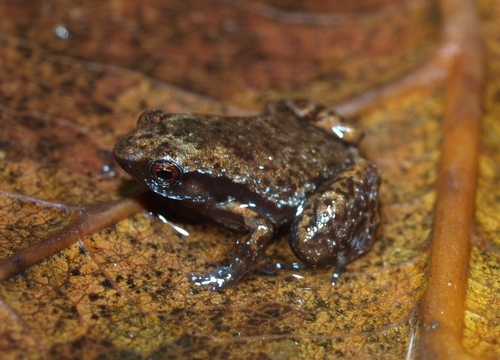
Cophixalus mcdonaldi is a small terrestrial microhylid frog endemic to the rainforests of northern Queensland, Australia. Like other members of its genus, it likely undergoes direct development, with eggs laid in moist terrestrial sites and hatching directly into froglets, bypassing an aquatic tadpole stage. This life history makes it particularly dependent on consistently damp microhabitats such as leaf litter, rock crevices, and moss-covered surfaces.
As an insectivore, the species contributes to invertebrate population regulation within its forest ecosystem, and in turn serves as prey for various native predators.
The species occupies subtropical and tropical moist lowland forest, permanent streams and rivers, and rocky terrain within a restricted range in Australia. Its reliance on stable moisture levels and specific microhabitat structures limits its distribution to intact forest patches.
Its Critically Endangered status stems from a combination of pressures. Habitat shifting driven by climate change and severe weather events threatens the cool, moist conditions the species requires. Logging, residential and commercial development, and agricultural expansion continue to fragment and degrade remaining habitat.
Invasive species and associated diseases, along with problematic native species interactions, add further biological stress, while pollution from urban runoff and solid waste accumulation degrade water and soil quality in its range.
Conservation attention for Australian rainforest-restricted amphibians generally includes habitat protection within reserve systems, monitoring of population trends, and biosecurity measures aimed at limiting disease and invasive species spread. Given the reported stable population trend, current conservation and habitat protection efforts appear to be preventing further decline, though the species remains highly vulnerable due to its restricted range and specialized habitat requirements. Its long-term outlook depends on continued forest protection and mitigation of climate-related habitat change.
McDonald's Frog faces ongoing habitat destruction from logging, land clearing for housing and farming, and litter and waste pollution in its environment. It also struggles against invasive species, competition or disease from other native animals, and pollution washing in from urban areas, while a changing climate brings more extreme weather that further disrupts its habitat. Taken together, these combined pressures suggest the threats to this species are intensifying rather than easing.
Habitat
This species inhabits wet sclerophyll forest and rainforest margins in the McPherson Range of southeastern Queensland, Australia. It requires moist leaf litter and vegetation near permanent water sources for breeding and shelter.
Conservation measures underway
Other threatened species in MICROHYLIDAE
Threatened in Australia
Frequently asked questions
Why is Mcdonald’s Frog classified as Critically Endangered?
Where does Mcdonald’s Frog live?
What are the main threats to Mcdonald’s Frog?
Get weekly conservation intelligence
One short digest a week of the most striking species and country data we ship, plus breaking conservation news paired with our database where it matters.
Free, no spam. One-click unsubscribe in every email.