Mountain-top Nursery-frog
Cophixalus monticola
Overview
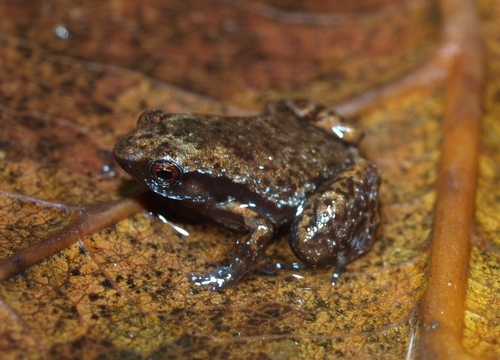
Cophixalus monticola is a small terrestrial-breeding microhylid frog restricted to high-elevation habitats in Australia. Like other members of its genus, it lacks an aquatic tadpole stage, with eggs laid in moist terrestrial sites and young emerging as fully formed froglets, a reproductive strategy that reduces dependence on standing water. Its diet likely consists of small invertebrates, and its cryptic, secretive habits make it more often heard than seen, with males vocalizing to attract mates during warm, wet conditions.
Within its ecosystem it contributes to invertebrate population regulation and serves as prey for various native predators.
The species occurs in subtropical and tropical moist forest, along with rocky areas, typically at mountain-top elevations that provide cooler, more humid microclimates. This restriction to isolated high-elevation habitat "islands" makes it highly vulnerable to environmental change, as populations cannot easily disperse to new areas if conditions shift.
Threats include invasive species and disease, as well as pressures from native species interactions. Habitat loss and fragmentation stem from logging, agricultural expansion, and urban development, while garbage and solid waste accumulation degrade habitat quality. Climate change poses a particular risk, as rising temperatures can eliminate the cool, moist conditions this species depends on, with no higher ground available for upslope retreat.
Its naturally small population size further increases vulnerability to stochastic events and genetic decline.
Conservation efforts likely include habitat protection within protected area networks, monitoring of population status, and biosecurity measures to limit disease and invasive species spread. The population trend is currently assessed as stable. However, given its Critically Endangered status, restricted range, and the ongoing, largely irreversible nature of climate-related habitat pressure, its long-term outlook remains precarious despite the present stability.
The Mountain-top Nursery-frog faces habitat loss from logging, land clearing for farming, and expanding urban development, which also breaks its remaining habitat into smaller, isolated patches. It is further threatened by disease, competition or predation from other species, litter pollution, and a shifting climate that alters temperature and rainfall patterns in its mountain habitat. Because its population is already small, these pressures are especially risky, and overall the threats appear to be ongoing and intensifying rather than stable or improving.
Habitat
This species inhabits cool, moist montane rainforests at high elevations, typically found in leaf litter and low vegetation of cloud forests. It requires specific microhabitat conditions with high humidity and stable temperatures characteristic of tropical mountain ecosystems.
Conservation measures underway
Other threatened species in MICROHYLIDAE
Threatened in Australia
Frequently asked questions
Why is Mountain-top Nursery-frog classified as Critically Endangered?
Where does Mountain-top Nursery-frog live?
What are the main threats to Mountain-top Nursery-frog?
Get weekly conservation intelligence
One short digest a week of the most striking species and country data we ship, plus breaking conservation news paired with our database where it matters.
Free, no spam. One-click unsubscribe in every email.