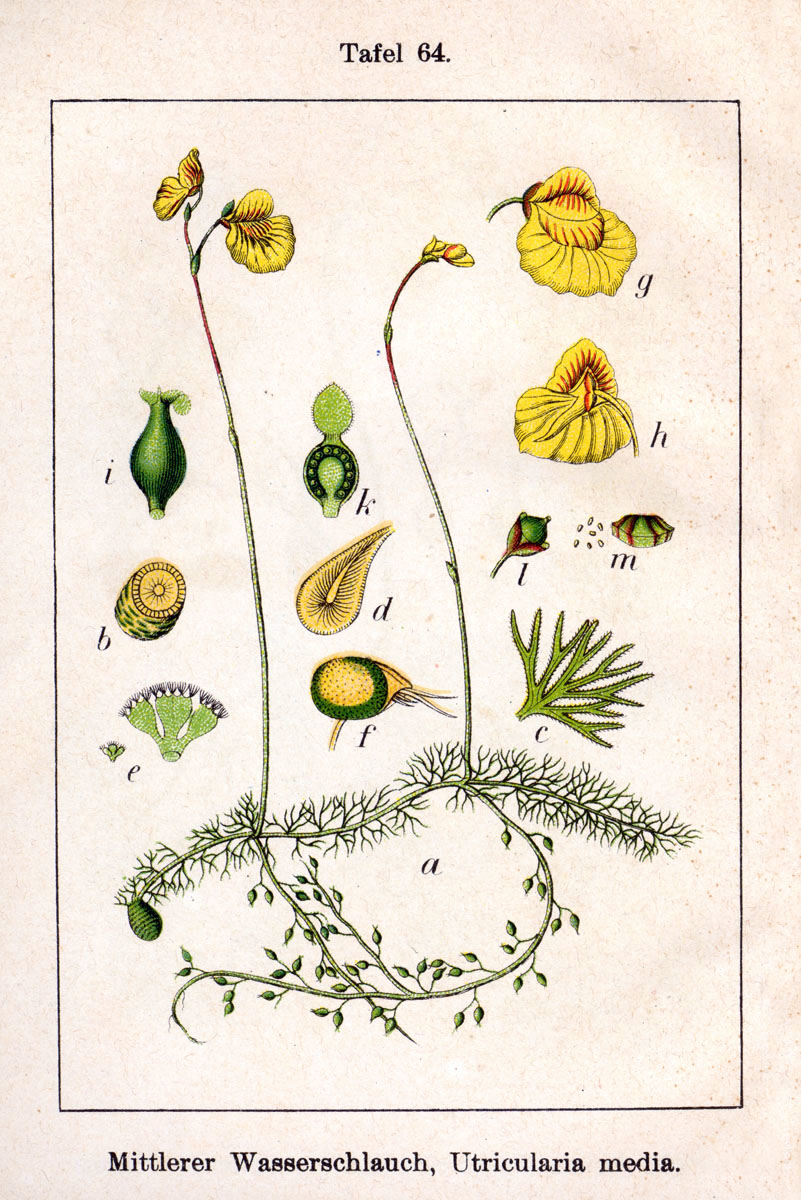
Flat-leaved Bladderwort
Utricularia intermedia
Photo: Wikimedia Commons (CC) via https://en.wikipedia.org/wiki/Utricularia_intermedia
Overview
Utricularia intermedia is a rootless, free-floating aquatic plant in the bladderwort family, distinguished by dimorphic shoots: photosynthetic green stems bearing flattened, divided leaves, and separate colorless underground stolons carrying small bladder-like traps. These traps capture and digest microscopic invertebrates such as water fleas and rotifers, an adaptation that allows the plant to supplement nutrient uptake in the nutrient-poor waters it inhabits. In summer, it produces small yellow, two-lipped flowers on emergent stalks above the water surface.
Within its ecosystem, it contributes to invertebrate population control and forms part of the specialized flora of nutrient-poor wetland communities.
The species has an extremely wide circumboreal distribution, occurring across northern Europe, Russia, East Asia, and North America, with additional scattered populations in Central Europe and even a disjunct record in Australia. It is restricted to shallow, still, acidic waters of bogs, fens, and calcareous wetland pools, habitats characterized by low nutrient input.
Despite this broad range, the species is assessed as Critically Endangered due to cumulative pressures on its specialized habitat: drainage and destruction of wetlands, peat extraction, water pollution and eutrophication that disrupt the nutrient-poor conditions it requires, and climate-driven changes to bog hydrology. Invasive plant species further compete for space and alter water chemistry in remaining sites.
Conservation responses are largely embedded within broader wetland and peatland protection programs, including habitat restoration, rewetting of drained bogs, and regulation of peat extraction in some countries. No species-specific recovery programs are widely documented. Population trends remain unknown, and without targeted monitoring, the species' trajectory across its extensive but fragmented range remains uncertain.
This plant is losing its wetland and bog homes as they are drained or dug up for peat mining, while pollution from runoff feeds unwanted algae and plant growth that crowds it out. Rising temperatures are also changing the water levels and conditions in bogs that this plant depends on, and it faces increasing competition from invasive plants moving into its habitat. Overall, these threats appear to be ongoing and intensifying rather than improving.
Habitat
Acidic bogs, fens, shallow pools, and marshy areas with nutrient-poor waters, typically in montane and northern temperate regions. This carnivorous plant requires specific water chemistry conditions and grows submerged or floating in permanent or semi-permanent wetlands.
Other threatened species in Lentibulariaceae


Threatened in Åland Islands


Frequently asked questions
Why is Flat-leaved Bladderwort classified as Critically Endangered?
Where does Flat-leaved Bladderwort live?
What are the main threats to Flat-leaved Bladderwort?
Get weekly conservation intelligence
One short digest a week of the most striking species and country data we ship, plus breaking conservation news paired with our database where it matters.
Free, no spam. One-click unsubscribe in every email.