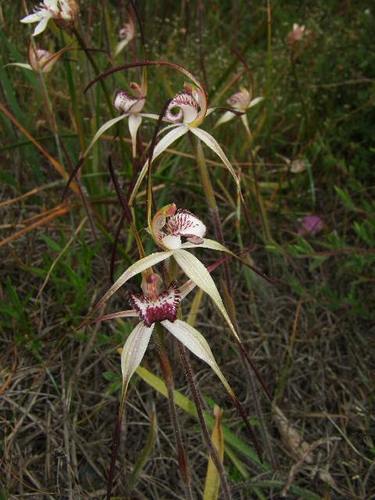
Mellblom's Spider Orchid
Caladenia hastata
Photo: (c) Reiner Richter, some rights reserved (CC BY-NC-SA), uploaded by Reiner Richter
Overview
Caladenia hastata is a terrestrial orchid producing a single hairy leaf and an erect flowering stem bearing one or occasionally two cream-to-white flowers marked with reddish stripes, typical of the spider orchid group within Caladenia. Like other members of this genus, it depends on a specific mycorrhizal fungus for germination and seedling development, and its flowers rely on pollination by native insects, likely through mimicry or food-deception strategies characteristic of the genus. Its ecological role is closely tied to intact soil fungal communities and native pollinator populations.
The species is restricted to coastal and near-coastal habitats in southern Australia, occurring in low-lying grassy woodland and heathland associated with supratidal marine zones. Its distribution is highly localised, with only a small number of known populations remaining.
The species faces numerous compounding threats. Livestock grazing and ranching activities damage plants and compact soil, disrupting the mycorrhizal fungi essential for its life cycle. Agricultural expansion, urban development, and habitat fragmentation have reduced and isolated suitable habitat.
Inappropriate fire regimes and fire suppression alter vegetation structure needed for flowering and pollination. Illegal collection of plants, invasive weeds and feral animals, and coastal activities linked to fishing and resource harvesting further degrade habitat quality.
Conservation actions include population monitoring, habitat protection within reserves, weed and grazing control at known sites, and research into mycorrhizal associations to support propagation and translocation efforts. Seed banking and ex situ cultivation programs have also been initiated to safeguard genetic material.
Despite these measures, the species remains classified as Critically Endangered with a decreasing population trend. Given its narrow range, small population size, and the persistence of multiple ongoing threats, its long-term survival in the wild remains uncertain without sustained habitat protection and active management.
Mellblom's Spider Orchid is mainly threatened by land being cleared or built on for farms, towns, and cities, which shrinks and breaks up its habitat into small, isolated patches. Grazing animals (both farmed livestock and wild/feral animals) trample or eat the plants, while foot traffic, digging, and other soil disturbance can damage the underground fungi the orchid depends on to survive, and weeds or introduced species crowd out its habitat further. On top of this, changes to natural fire patterns and people collecting the plants add extra pressure, and overall these combined threats appear to be ongoing and stable rather than clearly increasing or decreasing.
Habitat
Caladenia hastata occurs in open woodland and shrubland communities on sandy or gravelly soils in Western Australia's wheatbelt region. The species typically grows among low shrubs and grasses in areas with winter rainfall and dry summers.
Conservation measures underway
Other threatened species in ORCHIDACEAE
Threatened in Australia
Frequently asked questions
Why is Mellblom's Spider Orchid classified as Critically Endangered?
Where does Mellblom's Spider Orchid live?
What are the main threats to Mellblom's Spider Orchid?
Get weekly conservation intelligence
One short digest a week of the most striking species and country data we ship, plus breaking conservation news paired with our database where it matters.
Free, no spam. One-click unsubscribe in every email.