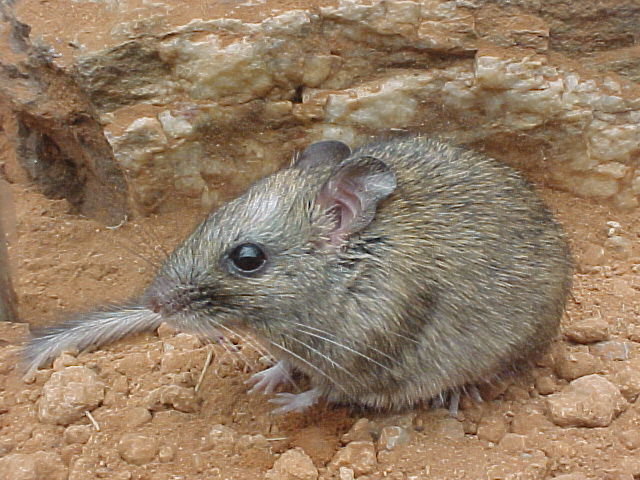
Central Rock-rat
Zyzomys pedunculatus
Photo: Photo: Wikimedia Commons, CC BY-SA
Overview
Status: Critically Endangered | Population Trend: Decreasing
The Central Rock-rat is a medium-sized native Australian rodent distinguished by a thickened, carrot-shaped tail base used for fat storage—an adaptation to the boom-and-bust resource cycles of arid environments. It is nocturnal and shelters by day in rock crevices, emerging to forage on seeds, plant material, and invertebrates. As a native granivore and insectivore, it plays a role in seed dispersal and nutrient cycling within its rocky desert habitat.
The species is endemic to central Australia, historically recorded across a wider range of the Northern Territory but now confirmed only in isolated, fragmented populations within rocky ranges and gorge systems, particularly in the West MacDonnell Ranges area. It relies on structurally complex rocky terrain interspersed with spinifex and other desert vegetation.
Its decline is driven by altered fire regimes—both large-scale wildfires and changes from historical Aboriginal fire management—which destroy the vegetation mosaics it depends on. Predation by feral cats and foxes, competition with European rabbits for food and shelter, and habitat degradation from livestock grazing compound these pressures. Climate change is further altering vegetation patterns critical to its survival.
Conservation efforts include predator control programs, fire management trials aimed at restoring patch-mosaic burning, monitoring of remaining populations, and consideration of translocation or captive breeding as insurance measures. Specific population figures are not reliably available, reflecting the species' rarity and the difficulty of surveying it.
Given the combination of restricted range, ongoing threats, and small, fragmented populations, the species' trajectory remains precarious without sustained, multi-threat management.
The Central Rock-rat is mainly threatened by frequent, intense bushfires that destroy the varied vegetation it needs for shelter and food, as well as by introduced predators like cats and foxes that hunt it. It also faces competition for food and habitat from rabbits, damage to its rocky habitat from grazing livestock, and shifting vegetation patterns caused by climate change. These combined pressures appear to be ongoing and intensifying rather than easing.
Habitat
Zyzomys pedunculatus inhabits rocky outcrops and boulder fields in arid central Australia, particularly areas with complex vegetation mosaics created by natural fire patterns. The species requires diverse microhabitats within these rocky environments, including crevices for shelter and adjacent areas with varying vegetation stages for foraging.
Conservation measures underway
Other threatened species in MURIDAE
Threatened in Australia
Frequently asked questions
Why is Central Rock-rat classified as Critically Endangered?
Where does Central Rock-rat live?
What are the main threats to Central Rock-rat?
Get weekly conservation intelligence
One short digest a week of the most striking species and country data we ship, plus breaking conservation news paired with our database where it matters.
Free, no spam. One-click unsubscribe in every email.