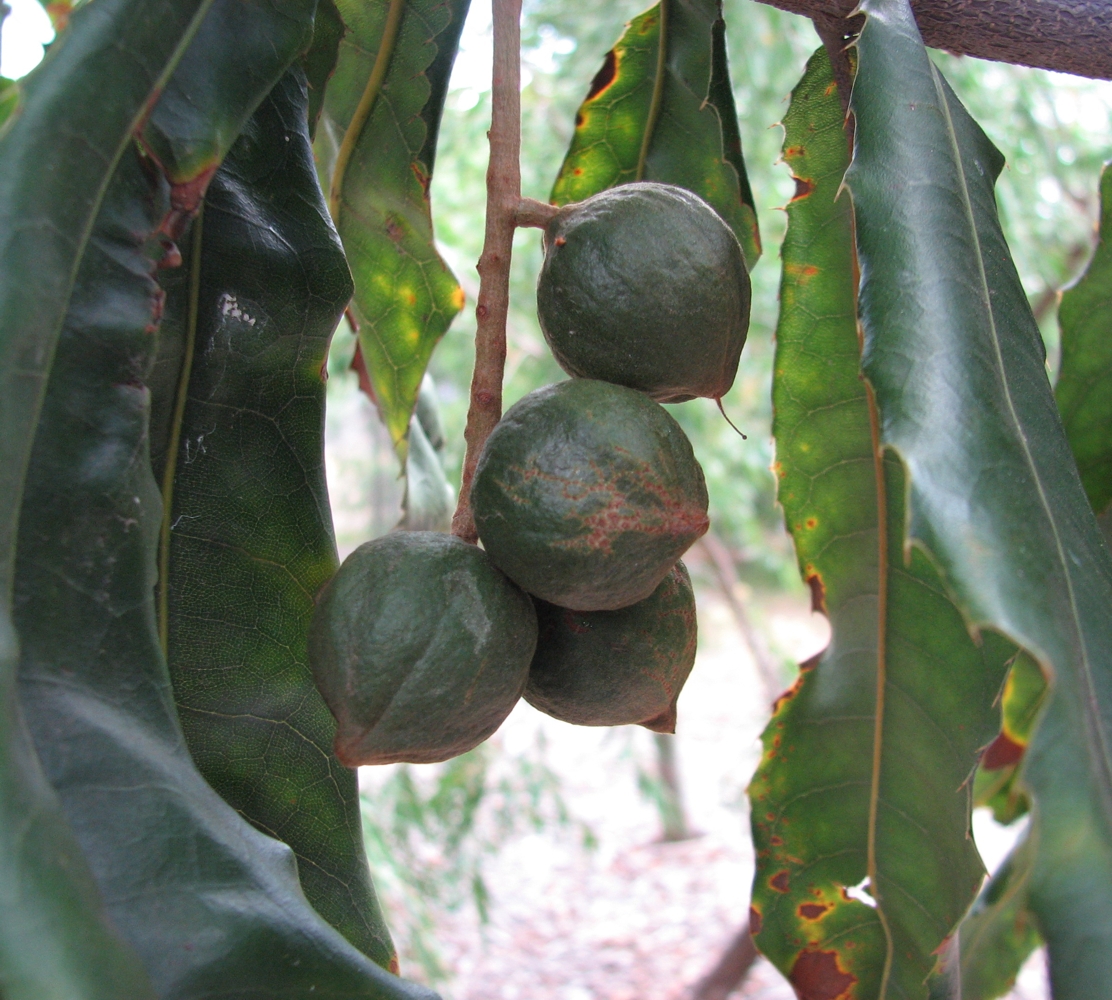
Macadamia tetraphylla
Photo: Wikimedia Commons (CC) via https://en.wikipedia.org/wiki/Macadamia_tetraphylla
Overview
This evergreen tree in the protea family reaches up to 20 meters in height, producing distinctive four-part leaf whorls (reflected in its species name) with spiny, serrated margins. It bears pendulous racemes of pink to purple flowers, followed by hard-shelled, round nuts encased in a green husk. As a component of the forest canopy, it provides food resources for native fauna and contributes to the structural complexity of the subtropical rainforest ecosystems it inhabits.
Its flowers attract insect pollinators, linking it into local pollination networks.
The species is endemic to a narrow strip of eastern Australia, occurring in subtropical lowland moist forest, along permanent rivers and streams, and in rocky terrain, primarily in southeastern Queensland and northeastern New South Wales.
Its restricted natural range has been heavily fragmented by land clearing for housing developments, agricultural expansion, and road and rail infrastructure. Fire regimes altered by human activity, unauthorized harvesting of nuts, hunting pressure on associated fauna, and pollution affecting waterway habitats compound these losses. A significant additional threat is genetic contamination and dilution through cross-pollination and hybridization with cultivated macadamia varieties grown extensively in commercial orchards nearby, threatening the genetic integrity of wild populations.
Conservation efforts include protection of some remaining habitat within reserves, seed banking, genetic research to characterize and safeguard distinct wild lineages, and community and landholder engagement programs aimed at protecting remnant populations on private land.
The species remains classified as Endangered, with population trends currently unknown due to limited monitoring data. Ongoing habitat fragmentation and genetic introgression from cultivated relatives present continuing challenges to the long-term persistence of genetically distinct wild populations.
Macadamia tetraphylla is losing habitat as land is cleared for housing developments, farming of crops, and road construction, while ongoing risks include unmanaged fire, harvesting or removal of wild plants, and cross-breeding with introduced or cultivated macadamia varieties that can dilute the genetic integrity of wild populations. Pollution and disturbance from wildlife hunting/trapping in its habitat add further pressure on the species. These threats are ongoing and appear stable rather than clearly increasing or decreasing based on current data.
Habitat
Other threatened species in PROTEACEAE
Threatened in Australia
Frequently asked questions
Why is Macadamia tetraphylla classified as Endangered?
Where does Macadamia tetraphylla live?
What are the main threats to Macadamia tetraphylla?
Get weekly conservation intelligence
One short digest a week of the most striking species and country data we ship, plus breaking conservation news paired with our database where it matters.
Free, no spam. One-click unsubscribe in every email.