Eptatretus longipinnis
Overview
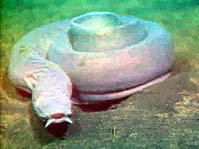
This elongate, jawless fish belongs to the hagfish family, characterized by a soft, scaleless, eel-like body and a skull composed of cartilage rather than bone. Like other hagfishes, it lacks true vertebrae and instead possesses a notochord, and it is equipped with slime glands along its flanks that release copious mucus as a defense mechanism against predators. Hagfishes are bottom-dwelling scavengers, feeding on dead and dying organisms on the seafloor, and in doing so they perform an important ecological role in recycling nutrients and clearing carcasses from marine sediments.
Their feeding activity also helps aerate and turn over bottom sediments, influencing local benthic ecology.
Eptatretus longipinnis is known from marine waters off Australia, where it inhabits soft sediment substrates on the continental shelf and slope. As with many hagfish species, it likely remains close to the seafloor, avoiding open water.
The species is classified as Vulnerable, with fishing and harvesting of aquatic resources identified as the primary ongoing threat. Hagfishes are frequently taken as bycatch in bottom trawl and trap fisheries targeting other species, and in some regions they are also harvested directly for their skin, used in leather products, and for food markets. Because hagfishes are typically slow-growing and long-lived, populations may be slow to recover from sustained fishing pressure.
Population trends for this species remain unknown, limiting the ability to assess recovery or decline with confidence. Specific targeted conservation measures for Eptatretus longipinnis are not well documented, though general fisheries management and bycatch reduction measures in Australian waters may offer indirect protection.
Given the ongoing pressure from fishing activities and the absence of clear population data, the species' conservation trajectory remains uncertain, underscoring the need for improved monitoring and species-specific management.
The main ongoing threat to this species is being unintentionally caught in fishing gear meant for other marine life, such as when it is scooped up as bycatch during commercial fishing operations. This ongoing pressure from fisheries activity continues to affect the species. Based on current information, this threat appears to be stable rather than clearly increasing or decreasing.
Habitat
Conservation measures underway
Other threatened species in MYXINIDAE
Threatened in Australia
Frequently asked questions
Why is Eptatretus longipinnis classified as Vulnerable?
Where does Eptatretus longipinnis live?
What are the main threats to Eptatretus longipinnis?
Get weekly conservation intelligence
One short digest a week of the most striking species and country data we ship, plus breaking conservation news paired with our database where it matters.
Free, no spam. One-click unsubscribe in every email.