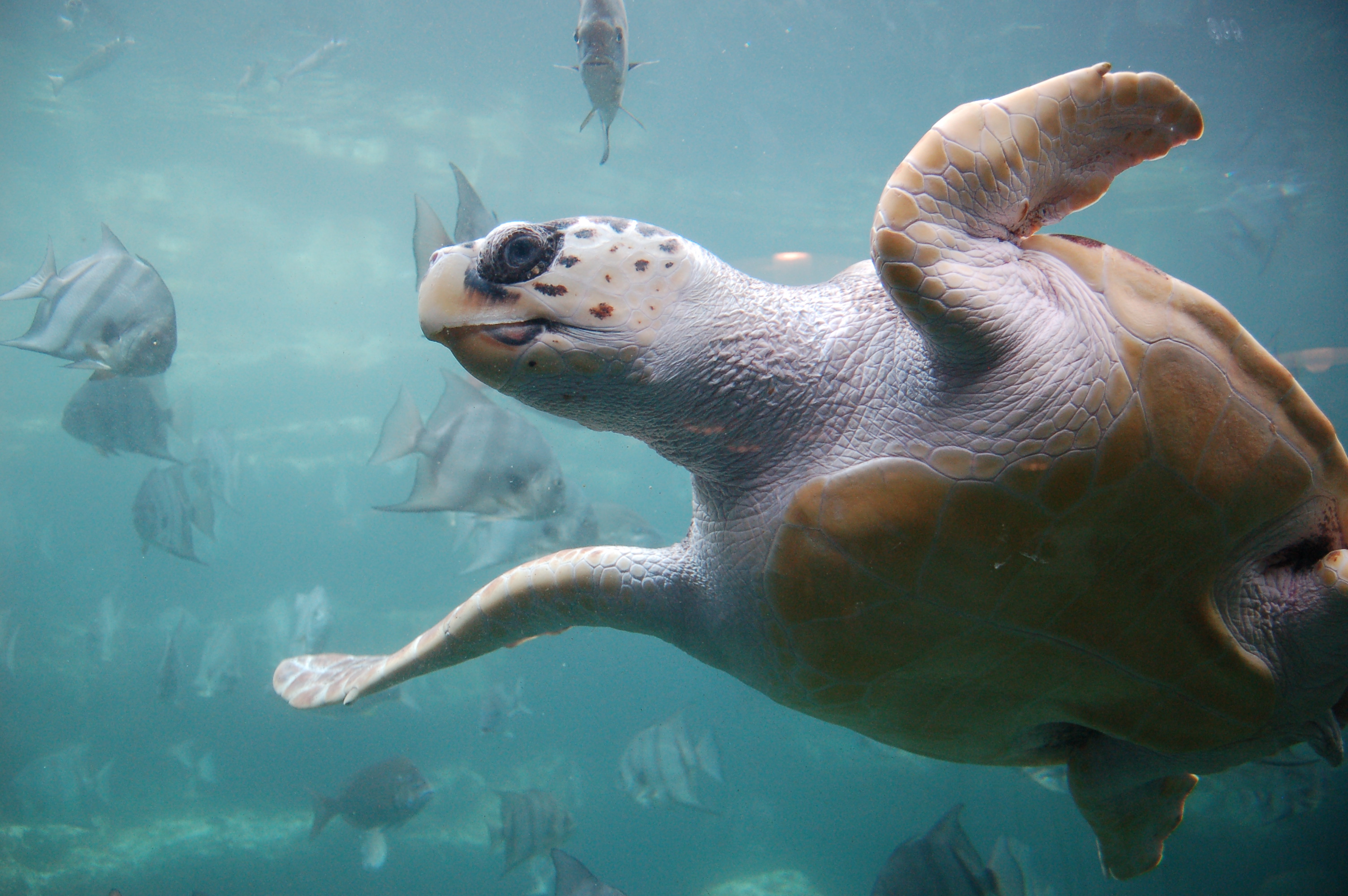
Loggerhead Turtle
Caretta caretta
Photo: Wikimedia Commons (CC) via https://en.wikipedia.org/wiki/Loggerhead_sea_turtle
Overview
The loggerhead turtle is a large marine reptile identified by its distinctively broad, reddish-brown carapace and powerful jaws adapted for crushing hard-shelled prey such as crabs, mollusks, and other invertebrates. Adults can weigh over 100 kilograms and are known for extensive migratory movements between foraging grounds and natal nesting beaches, a journey that can span thousands of kilometers across ocean basins. As a keystone species of marine and coastal ecosystems, loggerheads help regulate benthic invertebrate populations and their eggs and hatchlings provide a nutrient source for numerous coastal predators.
This species has a near-global distribution across tropical, subtropical, and temperate waters, occupying marine neritic, oceanic, and coastal/supratidal habitats. It nests on beaches and forages across an extensive range of countries spanning the Atlantic, Pacific, Indian, and Mediterranean regions, from the United States and Mexico to Greece, Japan, Australia, and Oman, among many others.
The species faces multiple ongoing pressures, including incidental capture in fishing gear, degradation of nesting habitat from coastal development and urbanization, ingestion of and entanglement in marine debris and solid waste, disease, and predation by native species on eggs and hatchlings. Storms, flooding, and shifting habitats linked to environmental change further threaten nesting success.
Conservation efforts include protection of nesting beaches, use of turtle excluder devices in trawl fisheries, monitoring programs, and international agreements addressing bycatch reduction. Numerous range states have implemented legal protections for nesting sites and adults.
Despite these measures, the population trend remains decreasing, and the species is currently classified as Vulnerable, reflecting continued cumulative pressure from fisheries interactions, habitat loss, and pollution across its range.
Loggerhead turtles are frequently caught unintentionally in fishing gear like nets and lines, and they suffer from beach habitat loss as coastal areas are developed for homes and buildings. They also face harm from ocean garbage and plastic pollution, disease, and increasingly unpredictable storms and flooding that damage their nesting beaches, along with shifting coastlines linked to environmental change. These combined pressures appear to be ongoing and stable rather than clearly worsening or improving based on current data.
Habitat
Conservation measures underway
Other threatened species in CHELONIIDAE

Threatened in Afghanistan

Frequently asked questions
Why is Loggerhead Turtle classified as Vulnerable?
Where does Loggerhead Turtle live?
What are the main threats to Loggerhead Turtle?
Get weekly conservation intelligence
One short digest a week of the most striking species and country data we ship, plus breaking conservation news paired with our database where it matters.
Free, no spam. One-click unsubscribe in every email.