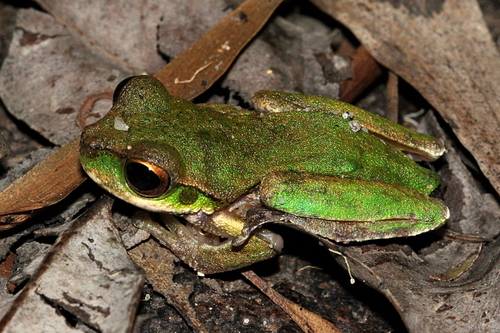
Kroombit Treefrog
Litoria kroombitensis
Photo: Photo: (c) Pete Woodall, some rights reserved (CC BY-NC), uploaded by Pete Woodall
Overview
Litoria kroombitensis is a small amphibian in the family Pelodryadicae, first described in the early 2000s from a highly restricted mountain range in central Queensland. Like other members of its genus, it is a nocturnal, stream-associated frog, likely relying on moist forest microhabitats for shelter during the day and calling from vegetation near watercourses to attract mates during breeding periods. As a predator of invertebrates and prey for larger vertebrates, it plays a role in the food web of its forest ecosystem, and as an amphibian it is also a sensitive indicator of environmental and hydrological health.
The species is known only from the Kroombit Tops area in southeastern Queensland, Australia, where it inhabits subtropical/tropical moist lowland forest at higher elevations. Its extremely restricted range makes it inherently vulnerable to localized disturbance.
Threats to its survival include altered fire regimes and fire suppression practices that change forest structure and moisture levels, livestock grazing that degrades riparian and forest-floor habitat, and logging activities that fragment or remove forest cover. Invasive species, including the amphibian chytrid fungus, pose a significant disease risk, while broader habitat shifting linked to climate change threatens the cool, moist conditions the species depends on.
Conservation attention has focused on habitat protection within its known range, ongoing population monitoring, and biosecurity measures to limit the spread of pathogens. Research into its ecology and distribution continues to inform management responses.
Given its extremely limited range, ongoing habitat pressures, and disease risk, the species' population is assessed as decreasing, and it remains at high risk of further decline without sustained habitat protection and disease mitigation.
The Kroombit Treefrog faces pressure from cattle grazing that damages its habitat, along with wildfires and the effects of fire management activities in the area it lives. It's also threatened by invasive species and diseases, ongoing logging and timber harvesting, and broader changes to its habitat driven by shifting environmental conditions such as a warming, drying climate. These threats are ongoing and show signs of intensifying, particularly as climate-related habitat changes and disease pressures continue.
Habitat
Conservation measures underway
Other threatened species in PELODRYADIDAE

Threatened in Australia
Frequently asked questions
Why is Kroombit Treefrog classified as Critically Endangered?
Where does Kroombit Treefrog live?
What are the main threats to Kroombit Treefrog?
Get weekly conservation intelligence
One short digest a week of the most striking species and country data we ship, plus breaking conservation news paired with our database where it matters.
Free, no spam. One-click unsubscribe in every email.