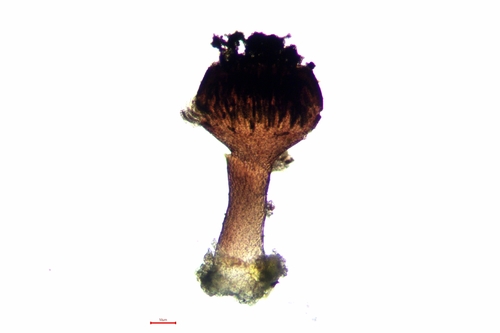
sphinctrina lichen
Sphinctrina leucopoda
Photo: Photo: (c) Jason Dart, some rights reserved (CC BY-NC), uploaded by Jason Dart
Overview
Sphinctrina leucopoda is a minute parasitic fungus that forms tiny, dark fruiting bodies on the surfaces of crustose lichens. This specialized parasite appears as small, black, pin-like structures with white stalks, measuring only 0.2-0.5mm in height. It plays a unique ecological role as an obligate parasite of specific lichen species, contributing to the complex microecosystem dynamics of lichen communities.
Sphinctrina leucopoda, a lichen species, faces severe threats primarily from habitat loss and degradation due to air pollution and climate change. The species is highly sensitive to environmental changes and requires specific substrate conditions that are increasingly rare in its native range.
Habitat
Sphinctrina leucopoda inhabits the surfaces of crustose lichens growing on the bark of old deciduous trees, particularly in humid, undisturbed forest environments. The species requires very specific microhabitat conditions with stable humidity and minimal air pollution, typically found in ancient woodland sites with continuous forest cover.
Other threatened species in Sphinctrinaceae
Frequently asked questions
Why is sphinctrina lichen classified as Critically Endangered?
Where does sphinctrina lichen live?
What are the main threats to sphinctrina lichen?
Get weekly conservation intelligence
One short digest a week of the most striking species and country data we ship, plus breaking conservation news paired with our database where it matters.
Free, no spam. One-click unsubscribe in every email.