
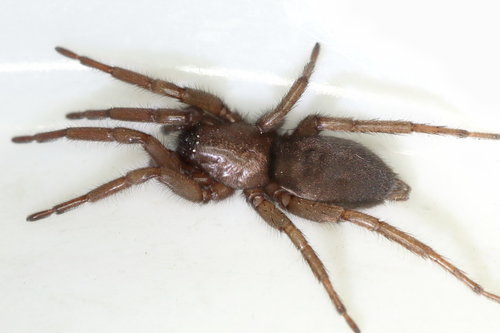
Cryphoeca silvicola
Photo: Wikimedia Commons (CC) via https://en.wikipedia.org/wiki/Cryphoeca_silvicola
Overview
Cryphoeca silvicola is a small spider belonging to the family Cybaeidae, order Araneae. Like other members of its genus, it is inconspicuous in size and coloration, typically found spinning inconspicuous silk retreats within moist microhabitats close to the forest floor. It plays a modest but consistent role in forest ecosystems as a predator of small invertebrates, contributing to the regulation of arthropod populations within leaf litter and deadwood layers.
The species has a wide but patchy distribution across much of temperate and boreal Europe, with records spanning Scandinavia, the Baltic states, Central and Eastern Europe, the British Isles, and parts of Southern Europe, along with isolated occurrences reported outside its core range. It is closely associated with old-growth and structurally complex forest habitats, particularly those retaining significant amounts of decaying wood and stable humidity levels.
Its endangered status stems primarily from the ongoing loss and degradation of old-growth forest habitat. Intensive forestry practices, including short-rotation timber management and the systematic removal of deadwood, eliminate the structural features the species depends on for shelter and prey availability. Habitat fragmentation further isolates populations, reducing dispersal and genetic exchange.
Climate change is also altering forest composition and microclimatic conditions in ways that may affect the species' long-term habitat suitability.
Conservation efforts remain limited and are largely indirect, arising from broader old-growth forest protection initiatives and deadwood retention policies in parts of its range. No dedicated recovery programs targeting this species specifically have been documented. Population trends remain unknown due to a lack of systematic monitoring.
Given continued pressures on forest habitat across much of its range, the species' long-term outlook remains uncertain, with persistence largely dependent on the protection of remaining old-growth forest fragments.
Cryphoeca silvicola is losing its home as old-growth forests are cut down and managed intensively for timber, leaving behind smaller, disconnected patches of suitable habitat. The removal of dead and decaying wood—an important microhabitat for this species—further reduces the places it can live, while shifting climate patterns are altering the makeup of forests it depends on. These combined pressures appear to be ongoing and show signs of intensifying rather than easing.
Habitat
The species is found in the litter layer of coniferous forests, from lowland regions up to low mountain ranges.
In Britain adult Cryphoeca sylvicola have been recorded as being active in all months of the year with peaks in the spring and early summer and in the autumn.
Threatened in Åland Islands


Frequently asked questions
Why is Cryphoeca silvicola classified as Endangered?
Where does Cryphoeca silvicola live?
What are the main threats to Cryphoeca silvicola?
Get weekly conservation intelligence
One short digest a week of the most striking species and country data we ship, plus breaking conservation news paired with our database where it matters.
Free, no spam. One-click unsubscribe in every email.