
Painted bug
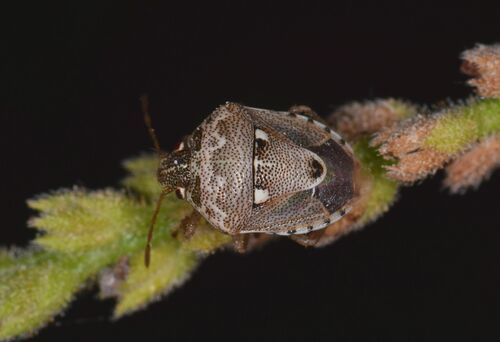
Eurydema dominulus
Photo: Wikimedia Commons (CC) via https://en.wikipedia.org/wiki/Eurydema_dominulus
Overview
Eurydema dominulus, commonly known as Karsetæge, is a distinctive shield bug belonging to the family Pentatomidae. This small hemipteran insect displays the characteristic pentatomid body shape with a broad, shield-like appearance and measures approximately 6-8 millimeters in length. The species exhibits striking coloration patterns typical of Eurydema bugs, with metallic green or bronze base colors adorned with contrasting markings that serve as warning signals to potential predators.
Karsetæge inhabits specialized grassland and meadow ecosystems across limited regions of northern Europe, where it feeds primarily on plants in the Brassicaceae family. The species shows a strong preference for undisturbed calcareous grasslands and traditional hay meadows that maintain diverse plant communities throughout the growing season. Adults are most active during late spring and early summer months, when they engage in mating behaviors and egg-laying activities on host plants.
The International Union for Conservation of Nature has classified Eurydema dominulus as Critically Endangered, reflecting the species' extremely restricted range and declining population numbers. This classification places the Karsetæge among the world's most threatened invertebrates, highlighting the urgent need for targeted conservation interventions. Despite its precarious status, recent collaborative efforts between entomologists and land managers have identified several previously unknown populations, offering hope for the species' long-term survival.
Conservation programs focusing on traditional grassland management practices have shown promising results in maintaining suitable habitat conditions for this specialized shield bug.
The primary threat to Eurydema dominulus stems from the intensification of agricultural practices that have eliminated the traditional hay meadows and extensive grazing systems essential for its survival. Conversion of species-rich grasslands to intensive crop production and the widespread use of pesticides have severely fragmented the bug's already limited habitat. Additionally, the abandonment of low-intensity farming practices has led to scrubland encroachment and changes in plant community composition that reduce the availability of suitable Brassicaceae host plants. Climate-driven shifts in precipitation patterns may further stress the specialized microhabitats required by this critically endangered shield bug.
Habitat
Eurydema dominulus occupies traditional calcareous grasslands and extensively managed hay meadows characterized by diverse plant communities and minimal chemical inputs. The species requires habitats that support robust populations of wild Brassicaceae plants, particularly those found in nutrient-poor soils with good drainage and exposure to full sunlight during peak growing seasons.
Other threatened species in Pentatomidae

Threatened in Austria
Frequently asked questions
Why is Painted bug classified as Critically Endangered?
Where does Painted bug live?
What are the main threats to Painted bug?
Get weekly conservation intelligence
One short digest a week of the most striking species and country data we ship, plus breaking conservation news paired with our database where it matters.
Free, no spam. One-click unsubscribe in every email.