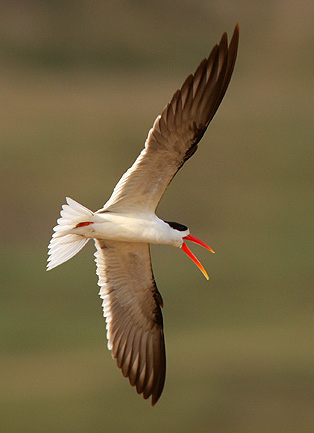
Indian Skimmer
Rynchops albicollis
Photo: Wikimedia Commons (CC) via https://en.wikipedia.org/wiki/Indian_skimmer
Overview
The Indian Skimmer is a distinctive waterbird characterized by its unique bill structure, where the lower mandible extends significantly beyond the upper mandible. This specialized adaptation allows the bird to skim water surfaces while flying, catching small fish and crustaceans. Adults display black upperparts with white underparts and a bright orange-red bill with a black tip.
These colonial nesters exhibit highly social behavior, forming flocks during feeding and roosting.
The species inhabits large river systems, estuaries, and coastal areas across South and Southeast Asia, with populations distributed from Pakistan through India, Bangladesh, Myanmar, Thailand, Cambodia, Vietnam, Laos, and extending to parts of China and Malaysia. They prefer sandy riverbanks, mudflats, and shallow coastal waters for foraging, while nesting on exposed sandbars during dry seasons.
Indian Skimmers face multiple interconnected threats contributing to their endangered status. River damming and water management projects alter natural flow patterns, reducing suitable sandbar nesting sites. Agricultural expansion and livestock grazing along riverbanks destroy critical habitat, while mining operations directly impact nesting areas.
Fishing activities increase human disturbance, and pollution degrades water quality. Climate-related flooding destroys nests, and invasive species compete for resources.
Conservation efforts include habitat protection initiatives in key breeding areas, community engagement programs with local fishing communities, and monitoring of known colonies. Several countries have established protected areas encompassing important skimmer habitats.
The species' outlook remains concerning, with continued population decline driven by ongoing habitat loss and human encroachment. Without intensified conservation measures addressing multiple threat factors simultaneously, recovery prospects appear limited.
The Indian Skimmer faces threats from multiple human activities that destroy or disturb its riverside and coastal habitats, including conversion of land for farming and livestock grazing, sand mining along riverbanks, dam construction that alters water levels, and expanding cities and towns. The birds are also affected by overfishing that reduces their food supply, pollution in waterways, flooding during severe storms, and competition from invasive species. These threats are ongoing and appear to be intensifying as human development continues to expand into the bird's remaining habitat.
Habitat
Conservation measures underway
Other threatened species in LARIDAE
Threatened in Bangladesh



Frequently asked questions
Why is Indian Skimmer classified as Endangered?
Where does Indian Skimmer live?
What are the main threats to Indian Skimmer?
Get weekly conservation intelligence
One short digest a week of the most striking species and country data we ship, plus breaking conservation news paired with our database where it matters.
Free, no spam. One-click unsubscribe in every email.