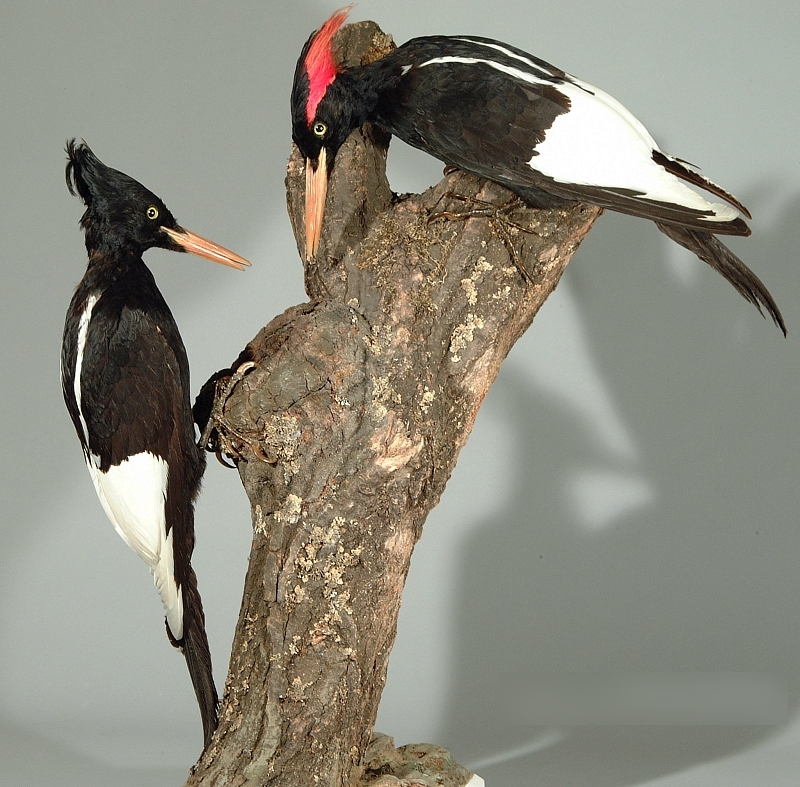
Imperial Woodpecker
Campephilus imperialis
Photo: Wikimedia Commons (CC) via https://en.wikipedia.org/wiki/Imperial_woodpecker
Overview
The imperial woodpecker is a woodpecker species endemic to Mexico. Measuring approximately 56–60 cm (22–23.5 in) in length, it is the largest known woodpecker. Because of its close taxonomic relationship and resemblance to the ivory-billed woodpecker, it is sometimes referred to as the Mexican ivory-billed woodpecker.
However, this name has also been applied to the extant pale-billed woodpecker. The bird was well known to the Indigenous peoples of Mexico, who had several names for the species. It was called cuauhtotomomi in Nahuatl, uagam by the Tepehuán and cumecócari by the Tarahumara.
The Imperial Woodpecker faces extinction primarily due to extensive logging of old-growth pine-oak forests throughout the Sierra Madre Occidental. Hunting pressure for specimens and traditional uses has further reduced the already fragmented population. Habitat conversion to agriculture and cattle ranching has eliminated critical nesting sites, while the species' dependence on large territories makes small forest remnants unsuitable for breeding pairs.
Habitat
The Imperial Woodpecker inhabits mature pine-oak forests in the Sierra Madre Occidental mountains of Mexico, particularly favoring areas with large Pinus and Quercus trees at elevations between 1,200-3,000 meters. The species requires extensive territories with abundant dead and dying trees for foraging on wood-boring beetle larvae.
Conservation measures underway
Other threatened species in PICIDAE
Threatened in Mexico
Frequently asked questions
Why is Imperial Woodpecker classified as Critically Endangered?
Where does Imperial Woodpecker live?
What are the main threats to Imperial Woodpecker?
Get weekly conservation intelligence
One short digest a week of the most striking species and country data we ship, plus breaking conservation news paired with our database where it matters.
Free, no spam. One-click unsubscribe in every email.