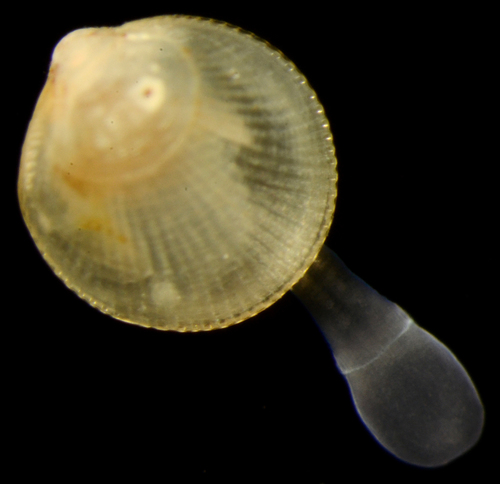
Horse-mussel
VU

Horse-mussel

Modiolus modiolus

Unknown

Photo: Wikimedia Commons (CC) via https://en.wikipedia.org/wiki/Modiolus_modiolus

Overview

Modiolus modiolus is a large, thick-shelled marine bivalve mollusc capable of reaching lengths of over 15 centimetres and living for several decades. It anchors itself to seabed sediments and hard substrates using byssal threads, often forming dense aggregations known as horse-mussel beds. These beds create complex three-dimensional structures that stabilize sediment, increase local biodiversity, and provide habitat and shelter for numerous associated invertebrate and fish species, making the species an important ecosystem engineer in the benthic communities it inhabits.

The species has a wide distribution across the North Atlantic and adjacent seas, occurring in coastal and shelf waters from subtidal zones down to depths of over 100 metres. It is recorded across a broad range of countries bordering the Atlantic and Pacific, including the United Kingdom, Norway, Canada, the United States, and many others, reflecting its tolerance for a range of temperate and boreal marine conditions.

Population declines are attributed to bottom-trawling and dredging, which physically destroy slow-forming reef structures that can take decades to recover. Coastal development, pollution, and eutrophication degrade water quality and smother beds with sediment, while ocean acidification threatens shell formation and structural integrity. Historical overharvesting for food and bait has also reduced some populations from which recovery has been slow.

Conservation measures include designation of some horse-mussel beds as protected marine habitats under regional and national frameworks, restrictions on bottom-contact fishing gear in certain areas, and ongoing habitat mapping and monitoring efforts. Population trends remain unknown in many regions due to limited long-term data.

Given the slow growth and recovery rate of this species combined with continued physical disturbance to seabed habitats, its conservation outlook remains uncertain, with recovery dependent on sustained habitat protection.

Horse-mussels are mainly harmed by fishing gear like trawls and dredges that scrape and crush their seabed reef habitats, along with coastal construction that disturbs the seafloor and pollution or nutrient runoff that degrades water quality. Rising ocean acidity linked to climate change makes it harder for them to build and maintain their shells, adding further stress on top of populations already reduced by past overharvesting. Overall, these combined pressures appear to be ongoing and intensifying rather than easing.

Threat summary

Habitat

Horse-mussels inhabit subtidal rocky and mixed sediment substrates in coastal waters, typically at depths of 5-280 meters throughout the North Atlantic. They form extensive reef-like beds that provide critical three-dimensional habitat structure for numerous other marine species in temperate shelf seas.

MARINE· major

Frequently asked questions

Why is Horse-mussel classified as Vulnerable?
Horse-mussel is classified as Vulnerable because the population is declining and the species faces a high risk of extinction in the medium-term future if current pressures continue. Horse-mussels are mainly harmed by fishing gear like trawls and dredges that scrape and crush their seabed reef habitats, along with coastal construction that disturbs the seafloor and pollution or nutrient runoff that degrades water quality. Rising ocean acidity linked to climate change makes it harder for them to build and maintain their shells, adding further stress on top of populations already reduced by past overharvesting. Overall, these combined pressures appear to be ongoing and intensifying rather than easing.
Where does Horse-mussel live?
Horse-mussel occurs in Australia, Bahamas, Belgium, Belize, Brazil, and Canada (plus 46 other countries). Country-level distribution data is sourced from the IUCN Red List and cross-referenced with GBIF occurrences.
What are the main threats to Horse-mussel?
The main threats to Horse-mussel are ai-1, ai-2, ai-3, and ai-4. The full IUCN-classified threat record for this species is detailed on the species page.

Get weekly conservation intelligence

One short digest a week of the most striking species and country data we ship, plus breaking conservation news paired with our database where it matters.

Free, no spam. One-click unsubscribe in every email.