Hemisaga lucifer
Overview
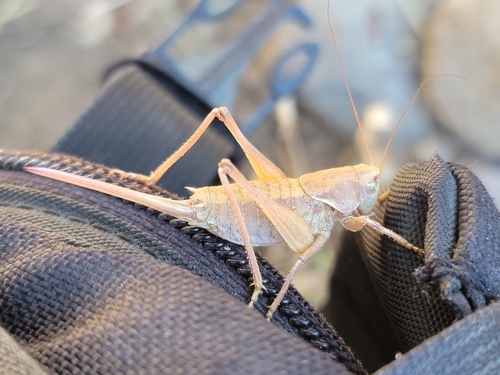
This large, flightless katydid belongs to the genus Hemisaga, a group of predatory and omnivorous bush crickets endemic to eastern Australia's rainforest habitats. Like other members of its family, it possesses enlarged hind legs for jumping, long thread-like antennae, and a robust body adapted to a ground-dwelling or low-vegetation lifestyle rather than flight. Individuals are typically nocturnal, sheltering by day in leaf litter, under logs, or in dense understory vegetation, and emerging at night to feed and forage.
As part of the forest floor community, they likely contribute to nutrient cycling and serve as prey for birds, reptiles, and small mammals, while also playing a role in controlling invertebrate populations through their omnivorous diet.
Hemisaga lucifer is restricted to terrestrial habitats within Australia, occupying moist forest environments where humidity and leaf litter depth support its life cycle. Its dependence on stable microhabitat conditions makes it particularly sensitive to environmental disturbance.
The species is classified as Vulnerable, primarily due to ongoing deforestation for agricultural expansion, urban and infrastructure development, and the resulting fragmentation of remaining forest patches. Climate change is altering temperature and moisture regimes within its microhabitats, compounding habitat loss. Collection for scientific specimens adds additional pressure on populations already constrained by limited range.
Specific population figures are not available, and the population trend is currently listed as unknown, limiting precise assessment of decline rates. Conservation attention has focused on habitat protection within its Australian range, though targeted management programs specific to this species are not well documented. Given continuing habitat pressures and the absence of clear population monitoring, the species' long-term outlook remains uncertain, contingent on the effectiveness of forest conservation and land-use planning in its range.
Hemisaga lucifer is losing its forest home as land is cleared for farming and urban growth, leaving the remaining forest patches smaller and more isolated. On top of this, shifting temperatures and moisture levels caused by climate change are altering the delicate microhabitat conditions this species relies on, and some individuals are also removed from the wild for scientific collections. Overall, these pressures appear to be ongoing and intensifying rather than easing.
Habitat
Hemisaga lucifer inhabits tropical and subtropical forests, typically found in areas with high humidity and stable temperature conditions. The species shows preference for undisturbed forest environments with dense canopy cover that maintains the specific microclimate conditions it requires.
Other threatened species in TETTIGONIIDAE
Threatened in Australia
Frequently asked questions
Why is Hemisaga lucifer classified as Vulnerable?
Where does Hemisaga lucifer live?
What are the main threats to Hemisaga lucifer?
Get weekly conservation intelligence
One short digest a week of the most striking species and country data we ship, plus breaking conservation news paired with our database where it matters.
Free, no spam. One-click unsubscribe in every email.