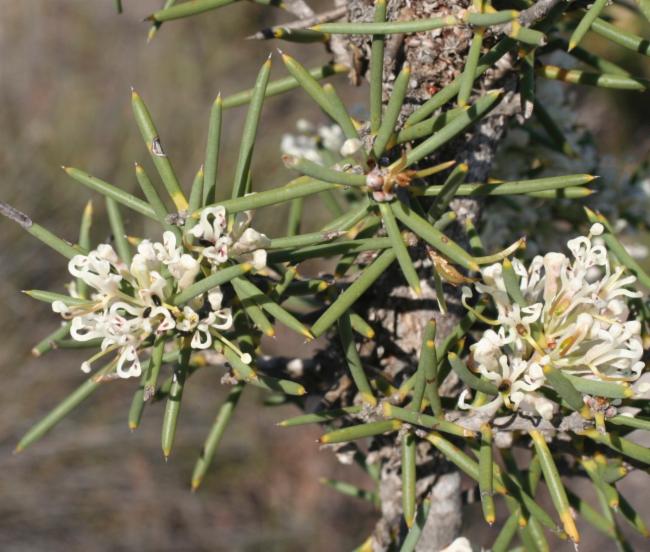
Hakea psilorrhyncha
Photo: Wikimedia Commons (CC) via https://en.wikipedia.org/wiki/Hakea_psilorrhyncha
Overview
Hakea psilorrhyncha is a woody shrub in the family Proteaceae, a group known for its tough, sclerophyllous foliage and distinctive woody fruits adapted to fire-prone Australian landscapes. Like other Hakea species, it likely produces small clusters of flowers that give way to hard, woody seed capsules capable of persisting on the plant for extended periods, releasing seed after fire or other disturbance. This serotinous strategy allows the species to regenerate following the periodic burns that shape its native shrubland habitat.
Within its ecosystem, the plant contributes structural diversity to the shrub layer and likely provides nectar resources for pollinating insects, consistent with the broader ecological role played by hakeas in Australian plant communities.
The species is endemic to Australia, where it occupies shrubland habitat. Its range is restricted, consistent with its listing as Endangered, and it is not known to occur naturally outside this limited Australian distribution.
The principal threat to Hakea psilorrhyncha is the ongoing conversion and disturbance of its habitat associated with annual and perennial non-timber crop agriculture. This land-use pressure reduces the extent and continuity of the shrubland the species depends on, fragmenting populations and limiting opportunities for natural regeneration.
Specific conservation measures for this species are not well documented in available records. Conservation of similar threatened Hakea species in Australia typically involves habitat protection within reserves, monitoring of remaining populations, and management of fire regimes to support seed release and germination.
Population trend data are currently unknown, making it difficult to assess whether the species is stable, declining, or recovering. Given the ongoing pressure from agricultural land conversion, the long-term outlook remains uncertain without targeted habitat protection.
Hakea psilorrhyncha is primarily threatened by the clearing of its natural habitat to make way for farmland used to grow crops season after season. This ongoing conversion of land for agriculture reduces the space available for the plant to grow and survive in the wild. This threat is currently ongoing and shows no clear signs of easing.
Habitat
Conservation measures underway
Other threatened species in PROTEACEAE
Threatened in Australia
Frequently asked questions
Why is Hakea psilorrhyncha classified as Endangered?
Where does Hakea psilorrhyncha live?
What are the main threats to Hakea psilorrhyncha?
Get weekly conservation intelligence
One short digest a week of the most striking species and country data we ship, plus breaking conservation news paired with our database where it matters.
Free, no spam. One-click unsubscribe in every email.