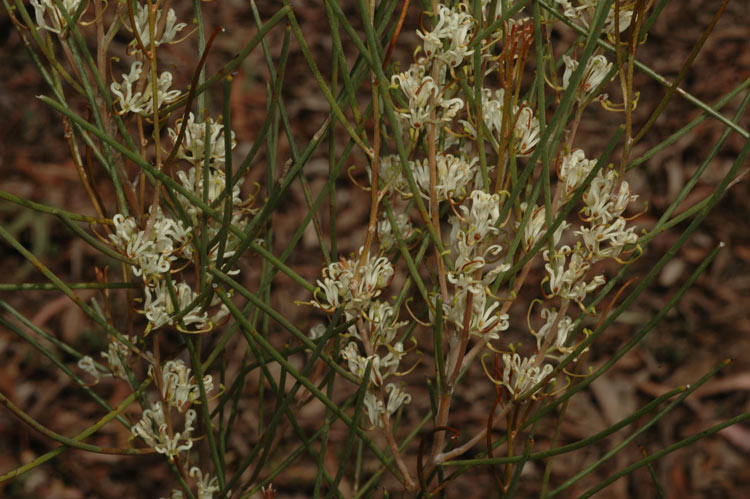
Hakea adnata
Photo: Wikimedia Commons (CC) via https://en.wikipedia.org/wiki/Hakea_adnata
Overview
Hakea adnata is a woody shrub in the family Proteaceae, characterised by the rigid, often needle-like or lobed foliage typical of the genus and the hard, woody seed capsules (follicles) that persist on the plant and open after fire or plant death. Like other Hakea species, it produces small clusters of flowers that offer nectar to insects and birds, contributing to pollinator networks within its shrubland community, and its seed bank stored in canopy-held capsules allows it to regenerate following disturbance.
The species is endemic to Australia, where it is restricted to shrubland habitat, a vegetation type that in the Australian context is often shaped by nutrient-poor soils and periodic fire.
Its Endangered status reflects several converging pressures. Conversion of native shrubland to annual and perennial non-timber cropland has reduced and fragmented available habitat. The species is also affected by problematic native species or disease, which may include competition, herbivory, or pathogen pressure from organisms naturally occurring in the region but acting adversely under altered conditions.
Additionally, changes to natural fire regimes—through either fire suppression or altered fire frequency and intensity—can disrupt the reproductive cycle of fire-adapted Proteaceae, affecting seed release and seedling establishment.
Conservation attention for this species is consistent with broader efforts across Australian threatened flora, including habitat protection within remaining shrubland remnants, monitoring of population status, and management of fire regimes to support natural regeneration cycles. Population trend data for Hakea adnata are currently unknown, limiting precise assessment of recovery or decline.
Given ongoing habitat conversion and fire regime disruption, the species' outlook remains uncertain, and continued monitoring will be necessary to determine whether current conservation measures are sufficient to stabilise its population.
Hakea adnata is mainly threatened by farmland expansion, as land is converted for growing crops, which destroys its natural habitat. It also faces pressure from native pests or diseases that harm the plant, as well as from wildfires and the way fires are managed or suppressed in its environment. These threats are ongoing and appear to be stable rather than clearly increasing or decreasing.
Habitat
Conservation measures underway
Other threatened species in PROTEACEAE
Threatened in Australia
Frequently asked questions
Why is Hakea adnata classified as Endangered?
Where does Hakea adnata live?
What are the main threats to Hakea adnata?
Get weekly conservation intelligence
One short digest a week of the most striking species and country data we ship, plus breaking conservation news paired with our database where it matters.
Free, no spam. One-click unsubscribe in every email.