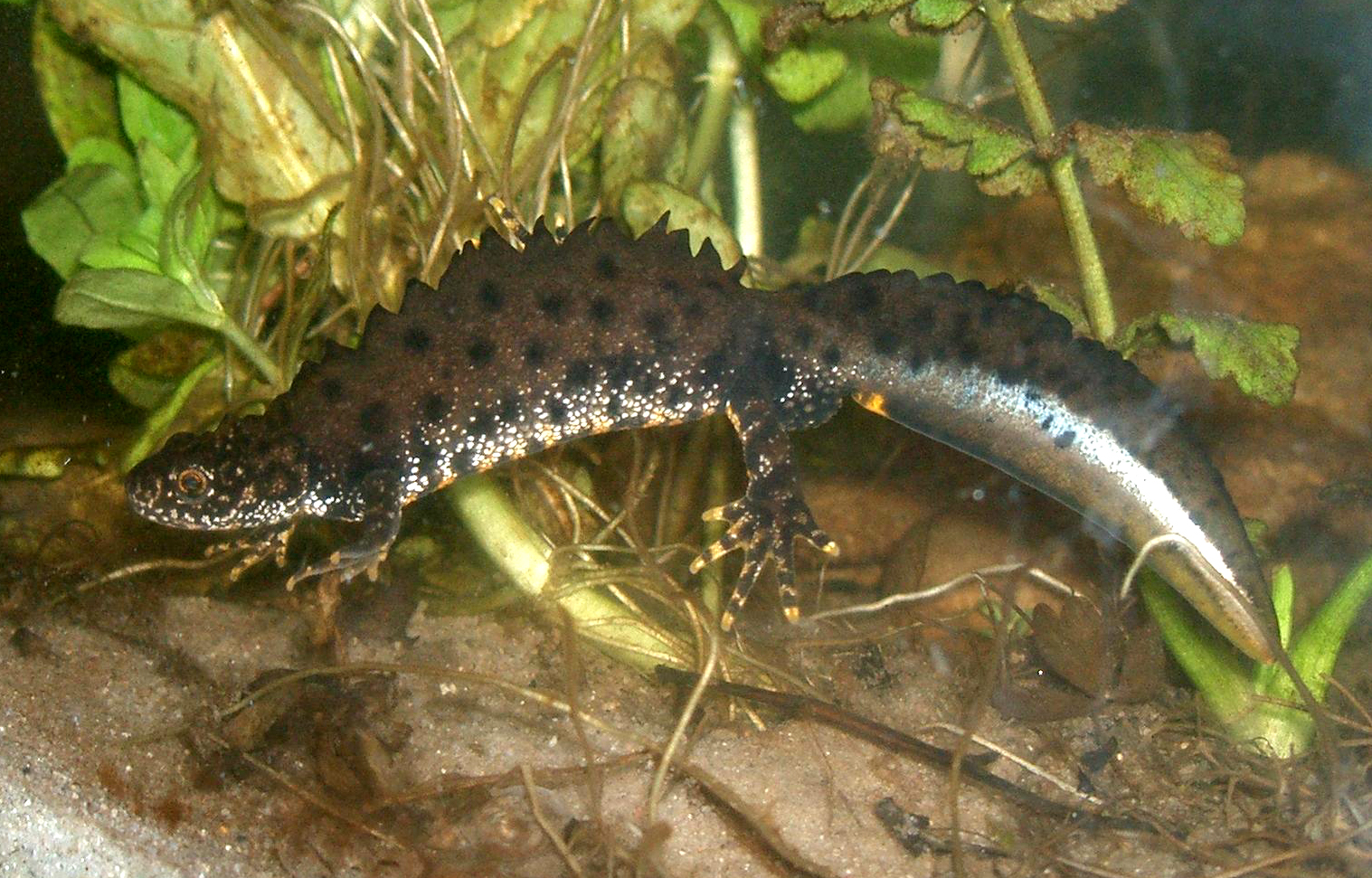
Great Crested Newt
Triturus cristatus
Photo: Wikimedia Commons (CC) via https://en.wikipedia.org/wiki/Northern_crested_newt
Overview
The northern crested newt, great crested newt or warty newt is a newt species native to Great Britain, northern and central continental Europe and parts of Western Siberia. It is a large newt, with females growing up to 16 cm (6.3 in) long. Its back and sides are dark brown, while the belly is yellow to orange with dark blotches. During the breeding season, males develop a conspicuous jagged crest on their back and tail.
The Great Crested Newt faces significant population declines across its range due to widespread habitat loss and degradation of its specialized breeding ponds. Agricultural intensification, urban development, and pollution have eliminated many of the clean, fish-free ponds essential for successful reproduction, while habitat fragmentation isolates remaining populations and reduces genetic diversity.
Habitat
Occupies a dual habitat system requiring clean, fish-free ponds, lakes, or ditches for breeding, along with adjacent terrestrial habitats including deciduous woodlands, hedgerows, rough grassland, and scrubland for foraging and overwintering. Adults typically remain within 500 meters of breeding ponds but may disperse up to 1 kilometer across suitable terrestrial corridors.
Other threatened species in Salamandridae
Frequently asked questions
Why is Great Crested Newt classified as Vulnerable?
Where does Great Crested Newt live?
What are the main threats to Great Crested Newt?
Get weekly conservation intelligence
One short digest a week of the most striking species and country data we ship, plus breaking conservation news paired with our database where it matters.
Free, no spam. One-click unsubscribe in every email.