
Giant Guitarfish
Glaucostegus typus
Photo: Wikimedia Commons (CC) via https://en.wikipedia.org/wiki/Common_shovelnose_ray
Overview
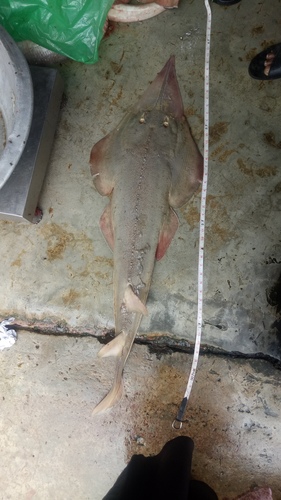
Glaucostegus typus is a large bottom-dwelling ray with a shark-like body plan, a flattened triangular snout, and broad pectoral fins fused to its head, giving it an intermediate appearance between sharks and rays. It can reach lengths of around three meters and is typically found resting on or moving slowly across the seafloor, where it feeds on crustaceans, molluscs, and small fish. As a benthic predator, it helps regulate invertebrate populations in coastal sediment communities.
The species occurs across the Indo-West Pacific, including the coastal waters of Vietnam, Australia, Indonesia, Papua New Guinea, Malaysia, the Philippines, India, Thailand, the United Arab Emirates, Singapore, Solomon Islands, and Taiwan. It inhabits marine neritic, intertidal, and coastal/supratidal zones, and can also enter freshwater and estuarine environments, generally staying close to shore over sandy or muddy substrates.
Population decline is driven largely by intensive, often unregulated fishing throughout its range. It is caught both as targeted catch for its high-value fins and meat and as incidental bycatch in commercial fisheries. Its large size, shallow-water habits, and slow reproductive rate make it especially vulnerable to overexploitation, as populations cannot rebound quickly from sustained fishing pressure.
Coastal habitat degradation, linked partly to nearby logging and land-use change, further reduces suitable nursery and feeding grounds.
Conservation measures include international trade restrictions on shark and ray products, regional fisheries management efforts, and some marine protected areas within its range, though enforcement remains inconsistent. Species-specific monitoring is limited in many countries. Given ongoing targeted exploitation, bycatch mortality, and habitat loss, the population trend remains decreasing, and recovery is expected to be slow even where protective measures are enacted.
Giant Guitarfish are caught both on purpose and by accident in fishing nets, prized for their fins and meat which are sold in international trade, while activities like logging near coastlines damage the shallow habitats they depend on. Because these animals grow slowly and reproduce infrequently, their populations struggle to bounce back once numbers drop. These combined pressures appear to be ongoing and show no signs of easing.
Habitat
Giant Guitarfish inhabit shallow coastal waters, estuaries, and continental shelves throughout the Indo-Pacific, typically found on sandy and muddy bottoms from the intertidal zone to depths of approximately 60 meters. Juveniles often utilize shallow bays and estuarine areas as nursery habitats, while adults may venture into deeper offshore waters.
Conservation measures underway
Other threatened species in GLAUCOSTEGIDAE


Threatened in Australia
Frequently asked questions
Why is Giant Guitarfish classified as Critically Endangered?
Where does Giant Guitarfish live?
What are the main threats to Giant Guitarfish?
Get weekly conservation intelligence
One short digest a week of the most striking species and country data we ship, plus breaking conservation news paired with our database where it matters.
Free, no spam. One-click unsubscribe in every email.