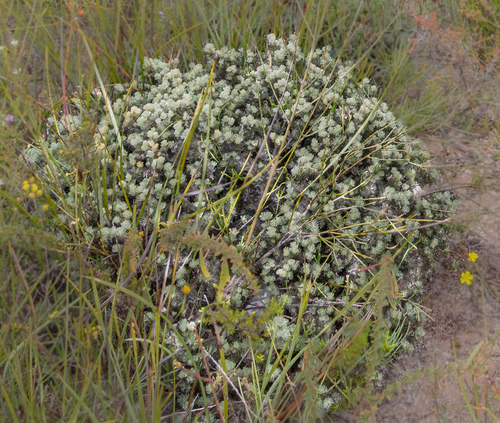
Fitzgerald Woollybush
Adenanthos dobagii
Photo: Photo: (c) vr_vr, some rights reserved (CC BY-NC)
Overview
This member of the Proteaceae family is a small, rigid shrub distinguished by its finely divided, needle-like foliage and the compact, tubular flower heads typical of the genus Adenanthos. Like other woollybushes, its flowers are adapted for bird pollination, producing nectar that attracts honeyeaters, which in turn contribute to seed dispersal and broader pollination networks within its shrubland community. The plant's dense growth form also offers shelter for small fauna, reinforcing its role as a structural component of the ecosystem it inhabits.
Adenanthos dobagii is restricted to a very limited range in Western Australia, where it grows in shrubland habitat, often on specific soil types that support the broader heath and shrub communities characteristic of the region's southwest botanical province. Its narrow distribution makes it inherently vulnerable to localized disturbance.
The species faces ongoing pressure from roads and railroad infrastructure, which fragment habitat and can alter drainage patterns and soil chemistry along verges where remnant populations persist. It is also threatened by problematic native species and disease, including dieback caused by the pathogen Phytophthora cinnamomi, which is known to devastate susceptible Proteaceae in the region by attacking root systems.
Conservation attention for this Critically Endangered species includes monitoring of known populations and management aimed at limiting the spread of Phytophthora through hygiene protocols in nearby infrastructure corridors. Habitat protection measures within its restricted range have also been considered given its conservation status.
The population is currently assessed as stable, suggesting that existing threats, while ongoing, have not yet driven further decline. However, its extremely restricted range and exposure to disease continue to place the species at high risk, warranting sustained monitoring and habitat safeguards to prevent future deterioration.
Fitzgerald Woollybush is threatened by ongoing road and rail construction or maintenance activities that can damage or destroy plants growing near these corridors, as well as by a harmful native plant disease (likely a root-rot pathogen) that continues to kill or weaken plants in its habitat. Both of these pressures are currently classed as ongoing rather than emerging or historical. Based on the available information, the threats appear to be stable rather than clearly increasing or decreasing.
Habitat
Conservation measures underway
Other threatened species in PROTEACEAE
Threatened in Australia
Frequently asked questions
Why is Fitzgerald Woollybush classified as Critically Endangered?
Where does Fitzgerald Woollybush live?
What are the main threats to Fitzgerald Woollybush?
Get weekly conservation intelligence
One short digest a week of the most striking species and country data we ship, plus breaking conservation news paired with our database where it matters.
Free, no spam. One-click unsubscribe in every email.