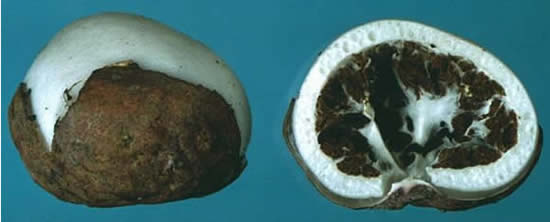
Fischer's Egg
Claustula fischeri
Photo: Wikimedia Commons (CC) via https://en.wikipedia.org/wiki/Claustula
Overview
Claustula fischeri is a sequestrate (truffle-like) fungus in the family Claustulaceae, related to stinkhorns within the order Phallales. Rather than producing an open, spore-dropping mushroom, it forms an enclosed, egg-shaped fruiting body at or below the soil surface, from which spores are dispersed once the structure ruptures, likely with the aid of insects or other invertebrates attracted by odor and tissue breakdown. As with many sequestrate fungi, it is thought to form mycorrhizal associations with forest trees, contributing to nutrient and water exchange in the root systems of its host plants and playing a role in forest soil ecology.
The species is known from forested habitats in New Zealand and Australia, where it occurs in leaf litter and soil beneath native tree cover. Its distribution appears naturally patchy and restricted to specific forest conditions.
The species is classified as Endangered, with a decreasing population trend. Key threats include ongoing habitat shifting and alteration, which degrades or removes the forest conditions the fungus and its host trees depend on, fire and fire suppression practices that alter soil chemistry and disturb the litter layer where fruiting bodies develop, and pressure from invasive non-native species and associated diseases, which can displace native host trees or disrupt soil communities.
Specific targeted conservation programs for this species are not well documented, but it benefits indirectly from broader forest conservation, protected area management, and invasive species control efforts underway in parts of its Australian and New Zealand range. Monitoring of sequestrate fungi remains limited due to their cryptic, below-ground fruiting habit, making population assessments difficult.
Given ongoing habitat pressures and limited targeted intervention, the species' outlook remains uncertain, with continued decline expected unless threats to its forest habitat are addressed.
Fischer's Egg is currently struggling because its natural habitat is being altered or lost over time, changing the conditions it depends on to survive. It also faces pressure from wildfires and the effects of efforts to suppress fires, which can disrupt the natural landscape it relies on. In addition, invasive species and diseases introduced from outside its native range are creating further strain on its populations. All three of these threats are ongoing, suggesting the pressures on this species remain steady rather than easing.
Habitat
Conservation measures underway
Threatened in Australia
Frequently asked questions
Why is Fischer's Egg classified as Endangered?
Where does Fischer's Egg live?
What are the main threats to Fischer's Egg?
Get weekly conservation intelligence
One short digest a week of the most striking species and country data we ship, plus breaking conservation news paired with our database where it matters.
Free, no spam. One-click unsubscribe in every email.