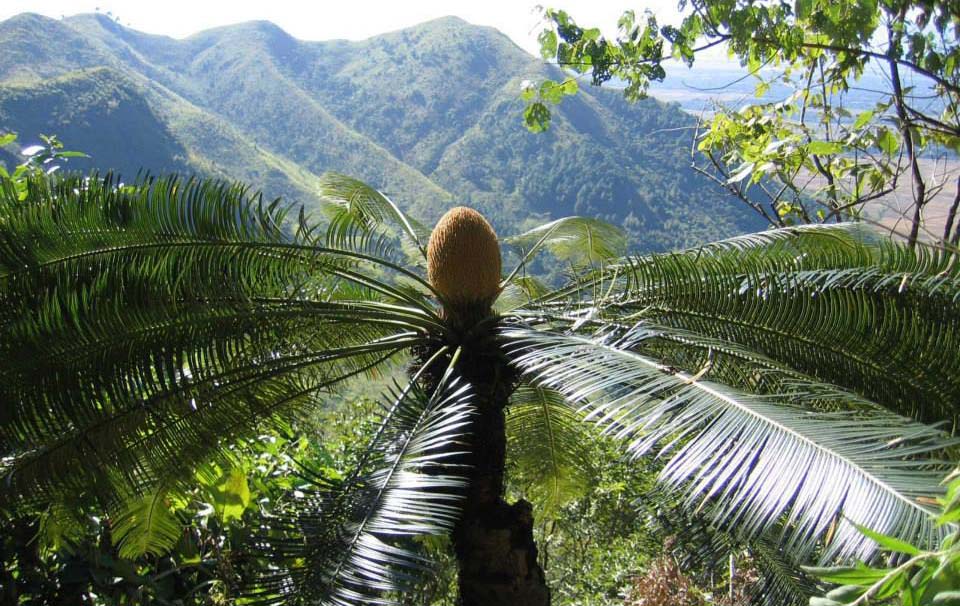
Cycas pectinata
Photo: Wikimedia Commons (CC) via https://en.wikipedia.org/wiki/Cycas_pectinata
Overview
Cycas pectinata is a large cycad species belonging to one of the world's most ancient plant families. This slow-growing gymnosperm can reach heights of 8-12 meters, featuring a thick, unbranched trunk crowned with distinctive feather-like compound leaves that can extend up to 2.5 meters in length. The species is dioecious, with separate male and female plants producing large reproductive cones.
As a primitive seed plant, C. pectinata plays an important ecological role in its native ecosystems, with its seeds serving as food sources for various wildlife species.
The species occurs across South and Southeast Asia, ranging from the Himalayan foothills in Nepal, Bhutan, and northern India through Myanmar, Thailand, Laos, Cambodia, and Vietnam, extending into southern China and Bangladesh. It typically inhabits tropical and subtropical forests, often growing on rocky slopes and hillsides at elevations up to 1,500 meters.
Cycas pectinata faces multiple threats contributing to its Vulnerable status and declining population trend. Agricultural expansion, particularly shifting cultivation practices and establishment of crop plantations, destroys its forest habitat. The species is also heavily exploited for its ornamental value, with plants harvested from wild populations for horticultural trade. Additionally, various plant parts are collected for traditional medicinal uses.
Conservation efforts include legal protection in several range countries and cultivation in botanical gardens for ex-situ conservation. However, enforcement of protective measures remains challenging across its extensive range. The species' extremely slow growth rate and reproductive maturity—often taking decades—makes population recovery particularly difficult, suggesting continued decline without enhanced protection measures.
Cycas pectinata faces threats from farmers clearing its forest habitat for crop farming and shifting agricultural practices that involve rotating between different plots of land. The plant is also being hunted and collected by people who use it for various purposes, while the animals that help disperse its seeds are being hunted and trapped, disrupting its natural reproduction cycle. These threats are currently ongoing and appear to be continuing at steady levels.
Habitat
Conservation measures underway
Other threatened species in CYCADACEAE

Threatened in Bangladesh



Frequently asked questions
Why is Cycas pectinata classified as Vulnerable?
Where does Cycas pectinata live?
What are the main threats to Cycas pectinata?
Get weekly conservation intelligence
One short digest a week of the most striking species and country data we ship, plus breaking conservation news paired with our database where it matters.
Free, no spam. One-click unsubscribe in every email.