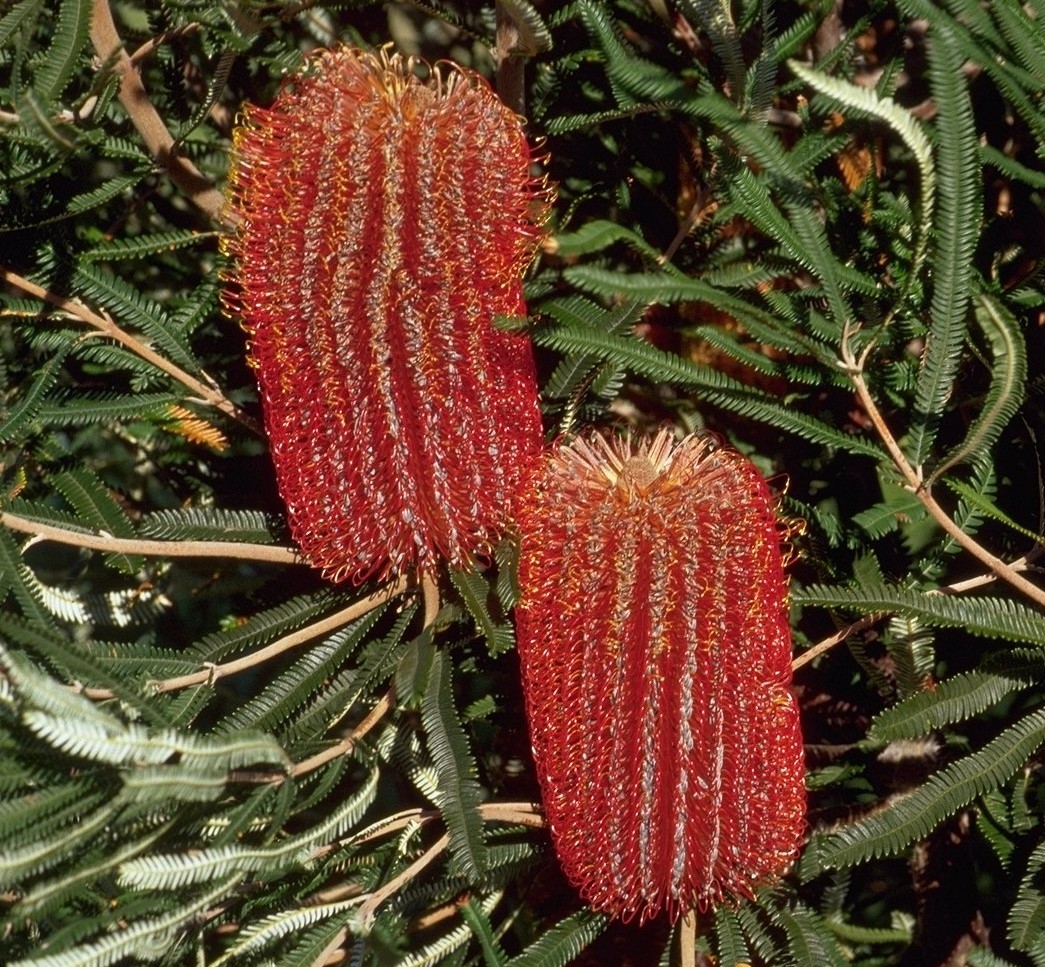
Banksia brownii
Local name: Brown’s Banksia
Photo: Wikimedia Commons (CC) via https://en.wikipedia.org/wiki/Banksia_brownii
Overview
Banksia brownii is a shrub in the family Proteaceae, typically growing as an upright bush with finely divided, fern-like leaves and distinctive cylindrical flower spikes in shades of orange-brown to rust red. Like other banksias, its dense inflorescences produce copious nectar that supports a range of birds, mammals, and insects, making it an important nectar source within its native plant communities. After flowering, woody seed-bearing follicles develop, often opening in response to fire, a key mechanism in its reproductive cycle.
The species is restricted to southwestern Australia, occurring in forest and shrubland habitats, particularly in areas with well-drained, sandy or gravelly soils typical of the region's heathland and woodland ecosystems.
Brown’s Banksia is classified as Critically Endangered, with a decreasing population trend. Its primary threat is dieback caused by the introduced pathogen Phytophthora cinnamomi, a root rot disease that kills susceptible plants and has severely fragmented populations. Altered fire regimes, including both fire suppression and inappropriate burning frequency, disrupt its natural regeneration cycle.
Agricultural and forestry runoff degrades habitat quality, while logging and land clearing have reduced and fragmented remaining populations.
Conservation efforts include hygiene protocols to limit the spread of Phytophthora, translocation of plants to disease-free sites, seed banking, and monitoring of wild populations. Some populations occur within protected areas, though management of fire regimes and pathogen control remain ongoing challenges.
The species' outlook remains precarious. Continued spread of dieback disease, combined with habitat disturbance and climate-related fire pattern shifts, suggests that without sustained intervention, further population decline is likely.
Brown's Banksia is under ongoing pressure from a plant disease (likely dieback fungus) spread by native organisms, chemical runoff from farming and forestry operations seeping into its habitat, and damage from logging and wood harvesting activities. Bushfires and the way fire is managed in its habitat also pose a continual risk, as this plant is sensitive to changes in fire frequency and intensity. All of these threats are currently classed as ongoing, indicating a stable but persistent level of pressure rather than a clear increase or decrease.
Habitat
Conservation measures underway
Other threatened species in PROTEACEAE
Threatened in Australia
Frequently asked questions
Why is Brown’s Banksia classified as Critically Endangered?
Where does Brown’s Banksia live?
What are the main threats to Brown’s Banksia?
Get weekly conservation intelligence
One short digest a week of the most striking species and country data we ship, plus breaking conservation news paired with our database where it matters.
Free, no spam. One-click unsubscribe in every email.